The Librarian’s Viewpoint

 I was particularly pleased to see that I handicapped the YA and juvenile Edgar awards pretty well. In fact, I picked both winners which was quite satisfying.

This month, I’m back with the third installment of Travis Thrasher’s Solitary series. I discovered them when I was offered a chance to review the first installment, Solitary, for the soon to vanish Canadian review site TCM-CA.com. I had never heard of the author, but was so impressed after reading the first book, I bought the rest of his adult books for the library. Travis is billed as a Christian writer, something that turns off a lot of potential readers. That, quite frankly is their loss. His writing has a grit and edginess that combines with spiritual beauty and a sense of hope/redemption. Everything I’ve read thus far has had an edge that makes it anything but sappy. Solitary hit the ground running and this third installment certainly holds the reader’s attention extremely well. I watched a podcast interview where Travis went into great detail about how the series was laid out, how his having attended four different high schools had influenced the plot and how his choices of music as a child of the ’80s continues to influence his writing
Temptation is a rocket of a book. I devoured it in about four hours, ignoring a beautiful sunny Sunday and flower gardens begging for my attention. The time wasn’t wasted. For reference purposes, I had gone to see the Hunger Games the night before and couldn’t help comparing the action in that film to the movie scrolling through my mind while I was reading this. Don’t bother reading it unless you have read Solitary and Gravestone because nothing, well almost nothing, will make sense. In Solitary, Chris Buckley fell in love with Jocelyn, beautiful, but wounded in ways she couldn’t or wouldn’t share with him. She was ritually murdered by a group of hooded men on New Year’s Eve at the end of the book, leaving Chris both angry and devastated.
Gravestone found Chris trying to figure out why she was murdered and a hell of a lot more: What was driving his mom to drink? What made the strange noises he heard beneath the cabin? Who could he trust? Why did every girl he cared about disappear? Why couldn’t others in Solitary see the overarching evil enveloping the town? Was the mysterious guy claiming to be his cousin for real? By the end of the second book, Chris still had loads of questions and very few answers. One thing was for certain, every time he started to reach out and trust someone, they were hurt or they betrayed him. Kelsey, the only normal girl Chris has met, scares him for that exact reason, forcing him to back away and leave her hurt and confused.

 Temptation begins with a quick peek from near the end of the book that sets the reader up nicely to wonder what in heck happened to get Chris to this point and place, but it’s a deceptive vignette as readers will discover. Chris is trying to stop feeling and just get by. He’s going to the first of two summer school sessions in order to catch up and be able to graduate. There are references to the Breakfast Club that will resonate with folks who grew up in that era. The other kids in this session are pretty odd and interesting; an Asian girl with big glasses who says little, a skinhead, a doper and a preppie among others. Then Lily walks in and Chris is smitten all over again. Blonde, sexy, and possibly attracted to him, she’s the perfect antidote to all the demons rumbling through his soul. Still, Chris can’t forget what happened to Jocelyn and then Poe. If he falls for another girl, will the evil forces lurking in the shadows destroy his latest chance for happiness? As the dance of romance progresses, Pastor Marsh starts coming around, teasing Chris with tidbits of information that start to clarify some of the odd happenings, but one mystery that refuses to be solved is what happened to Iris and her inn that burned near the end of Gravestone. No matter how often or how hard Chris searches, he can’t find the road leading to it.
By the end of Temptation, Chris has discovered why Pastor Marsh didn’t die when he stabbed him, he’s rekindled a relationship with the only truly good girl he’s met, he’s started to discover the parts of his family history that created all the sinister stuff smothering Solitary, NC., his mom and dad have started communicating again, Lily has confessed to things Chris certainly doesn’t want to hear and he has reached a huge turning point in his quandary about faith and evil. To say more about the plot would spoil some of the suspense and action, of which there is plenty of both. All 17 reviews on Amazon give this one 5 stars for very good reasons. It’s one scary ride and sets up what should be a fantastic toe-curling final installment due in January 2013.

Holly Cupala’s Don’t Breathe A Word is a story about suffocation and family preconceptions. Joy has suffered from severe asthma since early childhood. In fact, she almost died at one point. Her family has fallen into the mindset of her being the perpetual family invalid, with them hovering on the sidelines waiting for her next bad attack. When her older brother, the designated caretaker goes away to college, the family is more than happy to let suave, rich Asher, son of Joy’s dad’s employer, take over as both her boyfriend and caretaker. Unfortunately, everyone misses the growing signs of a controlling and very abusive relationship. When Asher forces Joy to do something that shocks and horrifies her, she decides to take a most desperate action, she fakes her own kidnapping and runs away to find a street kid she once saw in Seattle. Asher was verbally berating her at the time and the boy conveyed a cryptic message as he watched the event; “If you ever need me, I’ll protect you.” Joy hasn’t forgotten and plans her disappearance as carefully as someone with no street smarts can.
Her first few nights on the streets of Seattle are really scary and she loses much of her belongings and money when an older pedophile tries to attack her. When she does find Creed, the boy she’s looking for, he takes her in, introducing her to May and Santos, two other runaway teens who share the moldy, leaky and abandoned house that they call home. Joy learns many things the hard way: how awful things can be before kids do take to living on the street, what prior abuse can do to kids’ behavior in order to survive, how totally scary life with no safety net becomes when you have run out of inhalers, learning to dumpster dive for food and break into a YMCA in order to take a shower. The major mystery is why Creed and the others ran away from home and Joy has a very hard time getting that information while learning her street smarts. There are some really gritty scenes, bordering on awful in this book, but they make the reality of street life for kids as authentic as any book I’ve read. The ending will make you feel better and have a bit of hope that things will turn out as well as possible for Joy, Creed, May and Santos. The author has another book called Tell Me a secret which I have not read yet that I suspect is equally as good and would resonate with teen girls experiencing precarious living situations. That one is called Tell Me A Secret.

Posted in Uncategorized | 3 Comments

How to Judge a Book Cover

David Rotstein, the art director for Minotaur Books, recently launched a Web site devoted to a discussion of the fine art of designing book covers. It’s a pretty interesting peek behind the curtains at a process that is widely misunderstood by writers and readers alike.

People often ask me how much input I have into the covers of my books. The answer is “not much.” I can weigh in on the photograph or illustration the designer would like to use, and I can suggest that the type be bigger or smaller. But I don’t have a veto in my contract. And that arrangement is fine by me. If I wanted that level of control over every aspect of the book, I could always self-publish. But I prefer to avail myself of the expertise of a publishing house with thousands of titles in its catalogues. Authors don’t always like to hear it, but publishers are the one spending tens of thousands of dollars to design, print, and market our novels (after having already paid healthy advances, we should all hope). My name may be on the book, in other words, but their money is on the line.

Still, it’s natural that writers grouse when they feel a design fails to fully capture their stories. The essence of good marketing is delivering on a promise. That’s why most of us do judge books by their covers—in the expectation that what’s outside somehow represents what’s inside.

Here, for instance, is the design for the hardcover version of The Poacher’s Son. Minotaur wanted to market the book as a work of “literary suspense.” When they used this term, they had two audiences in mind: fans of traditional mysteries, of course, but also readers who wouldn’t normally pick up a whodunit, but would relish the father-son relationship at the book’s center. Most of the action takes place in the vanishing Maine North Woods, and so there was also a desire to capture the majesty of the setting.

When the time came for the trade paperback, Minotaur decided to switch out the design for something that emphasized the suspense. The book was going to be sold in airports to harried travelers who wanted to relax their brains for the lengths of their flights. Notice how the new design angles and fractures the font to suggest a fast-moving plot. The letters seem to hide behind the trees like a character on the run in the forest. I prefer this design to the hardcover. It’s closer to my own sense of the story—and it continues to sell well!

With the sequel came a new challenge. Minotaur wanted to brand my series so that the second book connected with the first book visually. But Trespasser was set during a different month (March) in a different place (the stormy coast). It was also more of an out-and-out thriller than The Poacher’s Son. Here is the solution David Rotstein’s team devised.The gray and orange are dramatic. They definitely leap out at you from across the bookstore.

The Trespasser paperback saw a few minor tweaks, aimed primarily at marrying the design with that of the The Poacher’s Son paperback since the two books would end up side by side on store shelves. The softcover gives you a chance to add blurbs from positive reviews, which we did.

My name also got smaller.

Not that authors care about such things.

Bad Little Falls was a combination of the title and the design clicking at the same time. We’d been debating two alternative titles (I’ll share that story in a future post) until David came up with his ominous illustration. Suddenly, the right choice seemed self-evident.

Will book buyers agree? We’ll know on August 7 when the novel arrives in stores.

Postscript: All three of my books will be coming out in the United Kingdom in 2013 from Constable & Robinson (the original publisher of Dracula, I always add). Recently, I got a look at the covers. You can see right away the totally different approach C&R has decided to go with. They have the advantage of bringing all three completed novels out together, so branding the books becomes an easier task. But it’s also a bigger gamble since choosing one design scheme for the series means it had better work, since the success of the entire enterprise is riding on the one template.

When you think about how the right cover can make or break a good book, it makes me glad all I have to do is write!

Posted in Paul's Posts | Tagged , , , , , , , | 3 Comments

Kaitlyn Dunnett Interviews Steve Steinbock

Please welcome a special guest to MaineCrimeWriters.com. Steve Steinbock is a mystery writer and reviewer who lives in Yarmouth, Maine. Currently he writes a regular review column, “The Jury Box,” for Ellery Queen’s Mystery Magazine and is working on a mystery series featuring a young rabbi living in a Maine college town. He regularly attends the mystery fan conventions Malice Domestic and Bouchercon, which is where I usually run into him. I think we’ve only met once when we were both in Maine, and that was at the Portland Jetport.

Kaitlyn: When we first met, at the Seattle Bouchercon in 1994, I had written a couple of mysteries for young people but was really there as a fan. Where were you in your mystery career?

Steve: At that time I was a fan and a budding scholar. I had aspirations to write mystery fiction, but I was really there because I loved the genre and wanted to know more about it. I grew up in Seattle and still had family there, so it gave me a good excuse. That Bouchercon in 1994 was my first mystery-fan experience ever.

Kaitlyn: Since you’re originally from Seattle, how did you end up in Maine?

Steve: I’d been making my way counter-clockwise around the country. After college (in Seattle) I went to grad school and worked for a couple years in California. Then a job offer took me to Norfolk, Virginia, where I met my wife. She was originally from New England. We had no desire to be in Greater Boston, but Maine was the best of all worlds.

Kaitlyn: Since 1994, you’ve written reviews for at least two significant mystery journals. Before Ellery Queen, you were review editor for The Strand Magazine. How did you get into that end of the business?

Steve: As I said, I saw myself as a budding mystery-scholar. I had been reading a lot within the genre, and a lot of classical criticism about the genre. One night I was having dinner with a friend who, at the time, was the restaurant critic for the Portland Press Herald. We were talking about literature, and I mentioned how much I’d love to review books. One thing led to another, and I found myself doing mystery and horror reviews for the Maine Sunday Telegram. I did that for several years, and at the same time began working with AudioFile Magazine (reviewing audiobooks and doing interviews and feature stories) and The Armchair Detective (which folded two issues after I began writing for it; I swear it wasn’t my fault). Since that time I’ve written for most of the mystery magazines: Crime Time (in the UK), Mystery Scene, Mystery Reader’s Journal, etc. I’ve been very lucky as far as my writing gigs have gone.

I had been friends with Professor Douglas Greene (a mutual friend with Kaitlyn Dunnett/Kathy Lynn Emerson). He introduced me to some great writers. I became friends with the editorial crew at Ellery Queen’s Mystery Magazine and Alfred Hitchcock’s Mystery Magazine. When the film “Secret Window” (based on a short novel by Stephen King involving Ellery Queen’s Mystery Magazine) was being released, Ellery Queen hired me to do a series of articles and interviews with Stephen King, director David Koepp, and several of the actors. About a year later, Columbia University was celebrating the 100th anniversary of Ellery Queen, and I wrote a couple of articles and spoke at the centenary symposium at Columbia.

When book critic Jon Breen decided to step down after thirty-five years with the magazine, I got a call.

Kaitlyn: You’re published in non-mystery nonfiction and in short mystery fiction, but you review primarily mystery novels. When you sat down to write your first mystery, did you find it helpful to have read so many works of fiction with a critical eye or did knowing all the pitfalls just make it that much harder?

Steve: Yes. All of the above. I knew what made a good mystery work. I knew the nitty-gritty of plotting. But throughout the process I found myself comparing my writing to that of the authors whose work I admire. I have to say that my background was more of a blessing than it was a curse, but then again, my novel is still in the shopping stage, and my only published fiction is a story in Ellery Queen.

Kaitlyn: Can you talk a bit about how you approach a novel you’re going to review?

Steve: Every book is a promise. Whenever a reader picks up a novel, they expect it to be good, whether it’s a thriller, a psychological suspense novel, a noir private eye novel, or a mystery about food or cats. I approach each book on its own merit. I’d much rather read a well-written cozy about a crime-solving pastry chef with a talking cat than a half-hearted international thriller. What I look for is whether the book kept its promise to the reader.

Kaitlyn: With the rise of the ebook and ereaders, do you see the ARCs now sent to reviewers being replaced with electronic copies? Or is this already happening?

Steve: When I began reviewing, I got a thrill every time the UPS man drove up to deliver a batch of review books. I love books, and love adding books to my library. Publishers would send finished books as well as ARCs (“advanced readers copies,” also known as “bound galleys”), and sometimes even unbound manuscripts. I love them all. But after almost twenty years, my house is only so big. “Electronic ARCs” take less shelf-space, and make my job as a reviewer easier. It’s been a slow change, but bit by bit publishers are getting on board and sending me links to electronic editions rather than physical copies. As a book lover and antique book collector, I still love physical books. But as a critic, I appreciate being able to read ARCs on my eReader.

Kaitlyn: When you aren’t reading mystery novels, what do you read and why?

Steve: I review upwards of a hundred books a year. That’s a lot of reading. Whenever I’m caught up,  I reward myself by reading a classic detective novel, usually by some obscure writer from before I was born.

Ironically, since I began reviewing for Ellery Queen, in spite of the increase in the number of new novels I read each month, I’ve found myself reading more non-fiction than ever before. I love linguistics, and am now reading The Language Instinct by Stephen Pinker and Through the Language Glass: Why the World Looks Different in Other Languages by Guy Deutscher. Ironically, these two books take opposite views of the role of language in thought. I also read a good amount about religious history and philosophy.

Kaitlyn: What are you working on now?

Steve: Other than this interview? I’m planning my next Ellery Queen column, as well as beginning the long process of trying to sell my novel to agents and starting on a second novel. I’m also editing a collection of non-mystery short stories by the prolific mystery short story writer Edward Hoch. I am teaching a class on Kabbalah, and I have a great idea for another non-fiction book I’d like to write.

Kaitlyn: And finally, one of our favorite interview questions here at Maine Crime Writers: What question have you always wanted to be asked in an interview? And, of course, go on to answer it.

Steve: What’s on your bookshelf?

Let me see. Currently reading Brownies and Broomsticks by Bailey Cates (Cricket McRae). It’s a mystery about a pair of café/bakery owners who happen to have spells up their sleeves. Total fluff, but I’m smiling all the way through. (When a book reviewer doesn’t start skimming pages, it’s a really good sign). Then there’s Driven by James Sallis, November Hunt by Jess Lourey, Deadlocked by Charlaine Harris. Pulse by John Lutz, Broken Harbor by Tana French, and Bagpipes, Brides, and Homicides by . . . wait a minute, is that you? Kaitlyn Dunnett!

As I said several questions ago, I like to read oldies whenever a window opens up. The last one I treated myself to was Mr. Pottermack’s Oversight by R. Austin Freeman, a wonderful book by a contemporary of Christie who is sadly forgotten today. Freeman is a favorite of mine. Waiting in the wings right now are League of Frightened Men by Rex Stout, The Scarab Murder Case by S.S. Van Dine, and some Christie. My all time favorite mystery by a no-longer-living American author is Night of the Jabberwock by Fredric Brown.

Kaitlyn, thank you for inviting me to chat with you. I do hope we run into each other somewhere soon, without having to go to the airport!

Kaitlyn: And thank you for sharing your insights and experiences. And for the unsolicited plug for Bagpipes, Brides, and Homicides (in stores in August).


Posted in Guest Blog | Tagged , , , , , , , | 4 Comments

In London, on the Beach

Greetings friends. Gerry Boyle here after a week away from Maine. I spent a few days in London–South Kensington, Mayfair, even some time in the Old Bailey, that venerable court where so many murderers have met their fate.

And every once in a while, I looked up to take in the view in the photo below.

Okay,  I wasn’t actually in London. I was on a beach on Florida’s east coast, just south of St. Augustine. We spent some time there with friends, and the four of us swam, biked, ate good food, went for long walks. And read books. A lot.

Mine was A Certain Justice by P.D. James. It’s a classic whodunit, set in London’s legal world, with barristers, solicitors (I had to look up the difference), a killing in “Chambers,” and a fine portrayal of a sociopathic murderer. The writing was precise and graceful, the plot unwrapped with that elegant confidence that marks James’s books. This was an Adam Dalgliesh mystery, though it was interesting to me as a mystery writer that the inspector didn’t appear until Chapter 12. (I’d never try that delayed entrance with Jack McMorrow or Brandon Blake).

But the other thing that I found fascinating about my engrossing visit to London–and the reason you’re reading this here– was the phenomenon of beach books, and the way we can lose ourselves in a book when the rest of life’s distractions and obligations are removed.

There were no televisions, laptops, iPads, or iPhones on the beach. No talk about work or the to-do list for coming days. Our distractions were sparkling green ocean, the rumble of the surf, and passing squadrons of gliding pelicans, whose shadows flickered across the page—momentary interruptions from our enjoyment of the work of Ms. James, Carl Hiassen and Clive Cussler, among others.

For me, this was a welcome and needed reminder of the power of the written word. Sometimes it seems books are getting lost in the din, and I find myself worrying that books have lost their power to hold readers and transport them to other worlds.

I came home tanned, refreshed, and optimistic. I just hope people remember that “beach reading” can happen anywhere. Just shut off the stuff and let the book take you away.


Posted in Gerry's Posts, Uncategorized | Tagged , , , , , , , , , , , , , , , | 1 Comment

What’s Lost in Translation?

James Hayman:  My wife Jeanne and I recently had dinner in Portland with a Swiss friend we’ve known since our days in Ridgewood, NJ.  Dagmar left New Jersey about the same time we did and returned with her husband and children  to her original hometown of Basel, Switzerland.  Like most Swiss, Dagmar is multi-lingual.  A native German speaker she also speaks and reads fluent English and French and thanks to a PhD in Norwegian Feminist Literature, Norwegian.

Since she’s an avid reader of fiction and an excellent judge of good writing, I was pleased when I finished writing the early drafts of The Cutting, Dagmar agreed to be one of my first readers.

A little over a year after The Cutting was published in the US, Limes, one of the Random House imprints in Germany, bought the German language rights to the book and published it in Germany and Austria and Switzerland.

As soon as the German version came out, I emailed Dagmar and asked if she would be willing to read it and let me know how good she thought the translation was and how faithful to the original.  She said she’d be happy to do that.

Over dinner at Pan Miyake, (an unusual and excellent  Japanese restaurant near Portland’s Longfellow Square), we discussed her thoughts.  To my surprise she said that while she thought the German translation of The Cutting was excellent, she had enjoyed the English language version of the book more. In fact, she said she generally prefers reading fiction in English rather than in German.  Since German is her native language, I asked her why she thought this was the case.

After giving it some thought she replied that partly because English had more words than German, it was a more artful language; in some instances less precise, but more filled with nuance and words and phrases that imply multiple layers of meaning. Naturally this can be a powerful tool for fiction writers.  Dagmar also said that she was not alone in this opinion.  Many other Europeans prefer reading British and American fiction in English rather than in translation.

I wondered if Dagmar was right that the English language did, in fact, have more words than German. When I got home I decided to check. What I found was that trying to figure out the exact number of words in any language can be a tricky endeavor.

The Duden, the major German dictionary, lists about 130,000 separate words.  The twenty-volume Oxford English Dictionary lists about 171,000 with another 9,500 derived words listed as subentries.  However an article on the subject that I found on the OED website (http://oxforddictionaries.com/words/how-many-words-are-there-in-the-english-language) sensibly concludes It’s impossible to count the number of words in a language, because it’s so hard to decide what actually counts as a word. Is dog one word, or two (a noun meaning ‘a kind of animal’, and a verb meaning ‘to follow persistently’)? If we count it as two, then do we count inflections separately too (e.g. dogs = plural noun, dogs = present tense of the verb). Is dog-tired a word, or just two other words joined together? Is hot dog really two words, since it might also be written as hot-dog or even hotdog?

It’s also difficult to decide what counts as ‘English’. What about medical and scientific terms? Latin words used in law, French words used in cooking, German words used in academic writing, Japanese words used in martial arts? Do you count Scots dialect? Teenage slang? Abbreviations?”

I also wondered if more people read in English because more people speak English than any other language. I decided to check this out as well.  It turns out (at least according to Wikipedia) that English has about 1.5 billion total speakers worldwide of whom 328 million are listed as native English speakers.  Mandarin Chinese has about 845 million native speakers and about 1.25 billion total speakers worldwide. Arabic is the third most spoken language and German is 11th with 90 million native speakers and 118 million total speakers worldwide.

English also has far more readers.  Of 100,000 books published in the UK every year only 3% are translated from other languages. On Google, I found a list of the best selling authors of all time, each of whom had sold over 100 million copies of their books.  Of the 82 authors on the list (ranging in talent from William Shakespeare to Danielle Steete) 64 wrote their original works in English.  Only 18 wrote in languages other than English.  (Interestingly, The Bible, which was originally written in a combination of Hebrew, Aramaic and Greek was not mentioned on the list).

While interesting, I’m not sure any of this actually means very much except that you’re far more likely to be published and read if you write in English rather than French, German or even Urdu.

Posted in Jim's Posts | Tagged , , , , , , | 2 Comments

Boothbay Harbor’s Fishermen’s Festival

Lea Wait, reporting.

Lots of festivals are held in Maine. The Lobster Festival in Rockland. The Clam Festival in Yarmouth. The Franco-American Festival in Waterville. The Highland Games in Topsham. The Balloon Festival in Great Falls. The Moxie Festival in Lisbon. Windjammer Days. County Fairs. An assortment of strawberry festivals and blueberry festivals. There used to be a Blueberries and Moose Festival, but it, sadly, was discontinued. All of those festivals are scheduled during summer months, and are designed to provide  fun, photo opportunities, plenty of local food, entertainment for visitors to Maine — and employment and income for residents. (Those of us who live here have also been known to enjoy a clam roll and a bottle of Shipyard Ale at one or more of those festivals, too.)

But a few festivals are really reserved for Mainers themselves. One of those is the annual Fishermen’s Festival in Boothbay Harbor, the 39th of which was held this year from April 27-30. The Fishermen’s Festival celebrates working fishermen and their heritage. There’s no glitz, no glamour, and no souvenirs, although you could buy a cup of coffee or a tee-shirt from seniors at Boothbay Region High School raising money for their graduation party. Most people attending live in Boothbay or one of the surrounding towns.

The festival started Friday night with a haddock dinner, followed by the Shrimp Princess Pageant, in which a dozen young ladies between the ages of 9 and 12 demonstrated their talents (most sang, but one played the violin and one jumped rope), and the winner was chosen Shrimp Princess. After the pageant those so inclined could adjourn to a local restaurant where Jehovah and the Holy Mackerels were playing until 1 a.m. 

Saturday there was food, beginning at 6 a.m. with a pancake breakfast at the Lions Club, and moving on to a fish fry and a lobster bake that basically went on all day, and ending with a church supper at the

Codfish Relay Race!

Congregational Church (2 seatings, one at 5 and one at 6 p.m.). Saturday was cold, even for a Maine April. Temperatures were in the high twenties, with 20-30 mph winds gusting from the ocean, when my husband and I arrived at 8 a.m. — in time to see the Codfish Relay Races — but the streets were full of excitement. The Codfish Races were followed by the Bait Shoveling Race, the Trap Hauling Competition, and, one of the highlights of the day, the Lobster Crate Running — in which participants must run along the tops of lobster crates strung between two town docks. A fall meant a dunking in 40 degree water. There was also Dory Bailing, Oyster Shucking, and an assortment of less strenuous activities for the youngest kids.

But if Saturday was the fun day, Sunday was really the heart of the festival.

At 1:30 Sunday afternoon the people of Boothbay Harbor gathered, as they do every year, at the Fishermen’s Memorial on the east side of the harbor to honor area fisherman who have been lost at sea. This is not done casually. The names of the 229 men whose names are engraved on the Memorial are read out loud, and a bell tolls for each of them. The first name is that of Captain John Murray, 27, who died May 17, 1798. Many of the names are from the same families: fathers, sons, brothers, fishing together. The worst single disaster was in October of 1851, when the S.G. Matthews was lost, taking with it thirteen men, 8 of them under the age of 21. Fishermen begin their profession young. Martin Lewis was only eleven when he was lost at sea in 1845.

Fishermen's Memorial, Boothbay Harbor

Many attending this year’s service were holding a list of the names read; each year it’s printed in the local newspaper. Many present had known men whose names were read. (No women are on the list. Yet.) Many who live in Boothbay and Boothbay Harbor today are the descendants of those honored. Preble. Clark. Tibbetts. Greenleaf. Gardener. Reed.  Hodgdon. Townsend. Pinkham.

Boothbay names. 

The last name carved on the monument is that of Roy Bickford, who died October 13, 2003. He fell overboard while lobstering aboard the Sharon Marie near Pemaquid. 

By next April’s Fishermen’s Festival there will be another name on the memorial. The men and women listening to the reading of the names were all too aware that just one week before the festival the body of lobsterman Earl Brewer was found, adrift, south of Squirrel Island. He had been alone on his fishing boat, the Sea Foam

After the reading of the names the fishing boats circled the inner harbor and passed the Fishermen’s Memorial so the fleet could receive blessings from the local clergy for a safe and profitable year. 

Maine may seem a scenic and somewhat romantic, perhaps even old-fashioned, Vacationland, to many. But for those who make their living from the waters, lobstering and fishing are still, over two hundred years since Captain John Murray lost his life at sea, hard and risky ways to make a living. For the fishermen of Boothbay and their families, taking time once a year to relax, celebrate their heritage, and acknowledge the risks of the new season, are reasons enough for a festival.   


Posted in Lea's Posts, Uncategorized | Tagged , , , , , , , , , , , | 7 Comments

A Mainer Thanks Vermont

It’s Vicki Doudera here, just back from five days in the Green Mountain State.

Nate receiving his diploma on Saturday.

The impetus for my trip was middle son Nate’s graduation from Champlain College, but I also visited aunts, uncles and cousins, held a book talk to promote DEADLY OFFER at the Barnes & Noble, and spent an afternoon walking along Lake Champlain. Thanks to my mother and grandfather being natives, I have lots of family and friends in Vermont, and have always felt at home there.
I can’t tell you how many summers and holidays I spent with my grandparents, Vic and Lena Guiduli, who were longtime restauranteurs in Barre. I have fond memories of that small town, known as the “granite capital of the world,” where everyone shopped on Main Street and greeted each other by name. I loved our trips to the lakeside cottages of my relatives or their friends, adored swimming in the clean waters and catching fish on the shore. I bicycled with Burlington cousins through UVM’s Redstone Campus, ate vanilla “creemies” in the countryside.

Statue of a granite sculptor in Barre.

I clamored to be taken to the “Farm,” my grandfather’s hunting camp in the Northeast Kingdom, a classic farmhouse without electricity nor plumbing on one hundred forested acres.
The Farm was where I first encountered “grown up” thriller novels — a stash of musty Ian Flemings — and where I fell in love with nature. Although my grandfather and his friends hunted just about everything that hopped, ran, or swam, they had a deep love of and respect for the woods and its inhabitants. We’d take long walks to the beaver dam, watch for bears lumbering up the power line, and look for deer in the fields at dusk. To me, it was heaven.

It was during the countless drives back home to Massachusetts that I realized I was not a city — or even a suburban — girl. I remember experiencing a sinking feeling, deep in my stomach, as we headed south through New Hampshire. I grew more and more depressed as the traffic increased, not because I didn’t like my life in Massachusetts, but because I absolutely hated leaving Vermont. My aunt reminds me of how I would “hide” in my grandparents’ closets so that my parents would leave me behind. On several occasions it actually worked.


Flash forward to my early twenties. Shortly after my husband Ed and I met in Boston, we realized that we both longed to be somewhere else. Somewhere cleaner, calmer, and wilder. Ed had friends in southern Vermont, and I had all my family connections, and so we decided to look for a business there. At the last minute we also contacted a business broker in a state where we knew absolutely no one — Maine.


Why Maine? We’d taken a spur-of-the-moment vacation to an empty cottage in Corea, a tiny Downeast coastal town, and magical things had happened. I’ll go into that in another post, but that’s the short answer of how Maine came to be in the running for our new home. A love of the ocean was another draw.


That we picked Maine over Vermont twenty-six years ago had more to do with the size of our bank accounts than anything else. Real estate in Maine was less expensive, and so we found ourselves purchasing an old Victorian in Camden, opening an inn, and rooting ourselves to a different part of Northern New England.


A funny thing happened the first time we traveled back to the coast from a trip to see relatives in Vermont. I braced myself for that sinking feeling, so much a part of every previous journey, and instead I felt — fine. Happy, even. Glad to have visited Vermont, but just as glad to be returning to Maine. As I write this I have tears in my eyes at the memory.


I’m grateful to beautiful Vermont, birthplace of my mother, grandfather, and scores of my loved ones and friends. I’m thankful for the way that state helped chisel me into who I am. I realize that it’s thanks to Vermont that I’ve built such a satisfying life in Maine, finding my own small town with its welcoming Main Street, as well as a mini version of the “Farm” where I can enjoy nature or read a musty Ian Fleming.

And I’m happy that — thanks to Vermont — I now have a graduate who is not only happy, but employed. Whew!


Posted in Uncategorized, Vicki's Posts | Tagged , , , , , | 8 Comments

My Desert Island Mystery Bookshelf

Kate Flora here, on a rainy day, thinking about weeding my bookshelves, which are double-shelved and groaning. I got distracted, thinking about all the books I can never let go of, and that led me to the question, for my fellow Maine Crime Writers: what are among your all-time favorite mysteries? Mine fall into three categories. First are the funny mysteries, those books that lightened my mood and sometimes made me laugh out loud. Chief among them is one by the English writer, Edmund Crispin. The book is called, The Glimpses of the Moon, and involves a pig’s head, something mysterious in a sack, and a pole that carries high-tension wires that gives off such an odd hiss it is known, locally, as The Pisser.

My second category is first novels in long-running series. My first nominee, in that category, is a book called China Trade, by S.J. Rozan. Shira published this book at the same time that my first Thea Kozak mystery came out, so I’ve always felt a real kinship with her. Her protagonists are a pair of PIs, Lydia Chin and Bill Smith, and she uses the ingenious device of alternating which of them will be the main protagonist and which will be the sidekick. China Trade features Lydia Chin, and I liked Lydia so much that I never wanted to the book to end. A close second, and a book I’ve reread several times in Robert B. Parker’s first Parker msytery, The Godwulf Manuscript. Wonderful to first meet Spenser, and Hawk,  and Susan Silverman (before I got really sick of her), and to watch Parker avoid the yuck factor despite having Spenser sleep with both a mother and her adult daughter over the course of the book. Parker made so many of us want to write mysteries and was a vibrant part of the community. I miss him.

Finally, there are psychological mysteries, and in this category, my nominees are both English, P.D. James, with An Unsuitable Job for a Woman, and Minette Walters, with The Ice House.

 Kaitlyn Dunnett: This is a tougher question than it seems. There are so many subgenres within mystery and each appeals to a different mood. When I want more of a challenge, I tend to read historical mysteries. If the setting is deep in the past, I can tolerate a much higher level of violence and/or despair in the lives of the characters. For contemporary settings, I prefer something much lighter. Without wishing to offend any of my fellow Maine Crime Writers, I hear enough about true crimes and behind-the-scenes police stories in real life. When I sit down to read in the limited time I have for that pleasure, I want to escape from all that.

So, what books do I hang onto and reread and cherish and buy as ebooks and audiobooks as well as in print format? First up are Elizabeth Peters’s Amelia Peabody books, starting with Crocodile on the Sandbank. Historical and funny. What more could I ask for? I’m currently working my way through this series for maybe the third time on Recorded Books audiocassettes (and I’ve read the books in print format more than once, too), listening for twenty-minutes or so at a time when I drive to the post office and run errands. The wonderful and talented Barbara Rosenblatt is the reader, which adds another layer to the pleasure. I’m also fond of other books by Elizabeth Peters, including a sprinkling of those classified as “gothic” and written under her Barbara Michaels pseudonym. Ammie, Come Home is a classic.

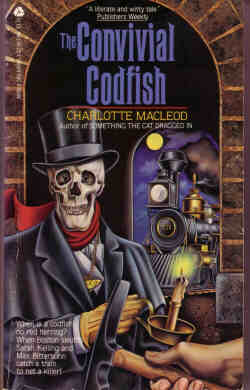
Among writers of humorous contemporary mysteries, no one can surpass the late, great Charlotte MacLeod, who lived in nearby Durham, Maine. So far, her books are not available as ebooks, which means I have to risk eyestrain to reread my battered old paperback copies. Barbara Mertz (aka Elizabeth Peters/Barbara Michaels) made the suggestion at Malice Domestic that we start a campaign to get these favorites (and others) back into print so that a new generation of readers can have the pleasure of discovering them. I sincerely hope this happens. As for my favoirte, I’m not sure I can pick just one novel, but my favorite title is The Convivial Codfish.

“So Many Books, So Little Time” is the slogan on a sweatshirt I own. So true! I don’t dare go look at the shelves full of books as I write this. My list would grow way too long. So, fast answer, as in first titles that pop into my head: Charlaine Harris’s Dead Until Dark; Margaret Maron’s Three Day Town (which won this year’s Agatha for best novel); our own Julia Spencer-Fleming’s In the Bleak Midwinter; the late Kate Ross’s Julian Kestrel Regency-era series, starting with Cut to the Quick (now reissued by a small press); Steve Hockensmith’s Holmes on the Range; and Lindsay Davis’s Silver Pigs. Julia Spencer-Fleming and Kate Ross write as “dark” as I like to go, and since both write books that fit into the Malice Domestic definition of a “traditional mystery” and have been honored with Agatha awards, that’s not all that dark!  What can I say? I read mysteries for pleasure!

Paul Doiron: I get the “favorite mysteries” question a lot at readings (I suspect we all do), and by now I should probably have better answers. It’s usually easier for me to recommend authors whom I’d admire than specific books. For instance, any mystery fan who’s read my novels can probably deduce that the late Tony Hillerman was a big influence, and yet I can’t name a single one of his books that stayed with me as a narrative in the same way that Jim Chee and Joe Leaphorn did as characters. I feel the same way about James Lee Burke’s Dave Robicheaux and Walter Mosley’s Easy Rawlins, too. My favorite contemporary crime novelist is Dame P.D. James (surprised, anyone?), but it’s for the consistency of her excellence, rather than one book that marked me for life.

When it comes to desert island books, my picks would probably lean toward the classics, starting with the singular Arthur Conan Doyle (who is so much in vogue again these days). Is it a cheat to pick The Complete Sherlock Holmes? If you put a gun to my head and made me choose, I’d probably be torn between The Adventures of Sherlock Holmes and The Hound of the Baskervilles—but fortunately we’re not pointing guns at each other, right, gang?

I feel the same way about the great Raymond Chandler whose sentences I prefer to Fitzgerald’s. Thank heavens the Library of America has seen fit to collect his first novels into one volume, although that edition excludes The Long Goodbye, which I consider his masterpiece, so I’d probably have to bring both volumes.

One book that I have mentioned before here, but which often gets excluded from the lists of classic mysteries due to its fantastical elements is The Strange Case of Dr. Jekyll and Mr. Hyde, which I will assert to my dying day is one of the best constructed mystery novels of all time. Like Bram Stoker’s Dracula (which is also in many ways a mystery, albeit a supernatural one, and considerably sloppier as it goes), the book uses diary entries and letters to slowly reveal information, carefully building suspense. Stevenson’s book is an early work of existentialism, and even when I am dead tired, I enjoy works that challenge me to think about my life’s choices in new ways.

I’d include in the though-provoking category such disparate works as Truman Capote’s “true crime novel” In Cold Blood and Norman Mailer’s sweeping counterargument The Executioner’s Song. And while I don’t tend to read John LeCarre much anymore, I think his Smiley saga—especially The Spy Who Came in from the Cold and Tinker, Tailor, Soldier, Spy—is a masterwork that taught me not to be afraid of complexity in my own fiction. Readers will follow you through a labyrinth if they have faith that you’ll show them a lighted doorway at the end.

And did I mention Dashell Hammett’s The Maltese Falcon? Can’t leave that one off the list.

Barb Ross: So many books, so little time, indeed, Kaitlynn. Books from series: P. D. James Original Sin, Ruth Rendell Simisola, Elizabeth George Playing for the Ashes, Dennis Lehane A Drink Before the War, Alexander McCall Smith No. 1 Ladies Detective Agency, Kate Atkinson, Case Histories, Louise Penny A Trick of the Light, and the late, great Ross Thomas Chinamen’s Chance, Out on the Rim and VooDoo, Ltd. Oh and Sharyn McCrumb The Rosewood Casket. (I know she doesn’t like to be called a mystery writer, but tough.)

Non-series: Barbara Vine Anna’s Book, Scott Turow Presumed Innocent (an almost perfect book imho–okay, maybe it’s not a standalone anymore) Minette Walters The Sculptress.

So, a lot of Brits, almost all living writers though some in their 80s and 90s, lots of stuff published in the 90s, lots of professional sleuths, lots of mysteries positioned as “literary,” and a lot of non-traditional structures. Don’t know what any of that means except clearly I am going to drown on my way to the desert island, since this is only the mysteries I’ll be carrying along with me.

Sarah Graves: So many of the greats have already been mentioned above that I’ll just bring up a few: James Ellroy’s American Tabloid, The Cold Six Thousand, and Blood’s a Rover are all big and strange, written out of a sensibility quite foreign to my own and expressed in a style that is unique to the author.

Likewise Thomas Pynchon’s Inherent Vice, Josh Bazell’s Beat the Reaper, and Jonathan Carroll’s The Land of Laughs vibrate with a kind of weird energy that makes it exciting to be a writer and a reader. Rose Macaulay’s The Towers of Trebizond must absolutely go into the desert-island book bag…but I’ll leave it to you to figure out what its mystery is.

Susan Hill of “The Woman in Black” fame writes the delicious Simon Serrailler crime series, starting with The Various Haunts of Men. Andrew Pyper, who wrote Lost Girls, has had his not-due-in-print-until-2013 The Demonologist optioned for film already.

And finally, I must slip two not-really-mysteries into my desert island go-bag: Let the Right One In and the book that comes after it, Handling the Undead, by John Ajvide Lindqvist, translated by Ebba Segerbert. The first is the smartest of vampire stories, the second a poignantly thoughtful zombie novel; I hope a third by Lindqvist comes soon so I can bring it along to our island-with-the-wonderful-library, too.


Tagged , , , , , , , , , , , , , , , , , , , , , , , , , , , , , , , , , , , , , , | 6 Comments

Rejection—Part Two by Barbara Ross

I wrote earlier this week about how I’ve experienced the act of rejecting as an editor. Today I want to talk about how I’ve come to think about rejection from the other side, as a writer.

Honestly, haven’t handled it well. Which is hard for me to admit, because, like most people, I don’t like talking about things I’m not good at. Very bad at, in fact. But I’m getting better.

When I first submitted my book The Death of an Ambitious Woman, I got interest from multiple agents right away. But then it didn’t sell to a publisher. For long, agonizing months, it didn’t sell. My agent told me it was the end of the line.

I was crushed. I didn’t write for months and then I started two books, neither of which made it past the first hundred pages. I had plenty of excuses. The company I had co-founded had taken off. My children were adolescents with all the activities and angst that brings. I was busy. I was miserable.

My writers group was patient and supportive. I started writing again. Short stories at first because I’d fallen in love with Alice Munro, and because they fit with my life. And eventually, much later, another novel.

But I’d lost a lot of time and it was, writing-wise, if not life-wise, a dark passage.

I used to wonder why I could pitch a company, and if investors weren’t interested, shrug it off and think, “your loss,” but rejection of my writing was so devastating. “Writing is so much more personal,” people would say. I really don’t think that’s it. Writing is more solitary, but your life and your ideas and your work are all personal, no matter what you do.

I think it’s about confidence. Not confidence about whether you are good or bad. But confidence that “there’s more where that came from.” For those of us who squeeze writing around jobs and families, who spend months on stories and years on novels, each product can become invested, weighted, with such hopes and dreams, as if it is the only chance.

I’ve lost forty-five pounds in the last year. (Great, how did this happen? Now I’m writing about the two subjects I’m most uncomfortable about.) I did it, mostly, by shifting my mindset from one of deprivation to one of abundance. Before, I had to eat that cannoli now because soon —tomorrow, next week, next month, next year—I was going on a diet. But now I think, there will always be more cannoli. So eating that one may not be so critically important.

“There will always be more words,” a woman in my writers group used to cheerfully say when advised to rip out a scene, ditch a character, kill a setting. I embraced it up to a point. Actually up to that point—the scene, character, setting point.

Now I see that for your mental health, writers have to embrace that philosophy all the way up the line. I think it’s what gives some people the magic confidence that allows them to think, “You don’t like it. Your loss.” Because I’m going to be right back at you with something else.

So say it. Think it. Live it.

There will always be more ideas.

There will always be more characters.

There will always be more books.

There will always be more stories.

There will always be more words.

There will always be more cannoli.

P.S. It all turned out okay with The Death of an Ambitious Woman, by the way. When I reread it years later, I was glad it wasn’t published, amazed it got as far as it did. I roto-tilled it, and did get published. It’s not necessarily an example of the philosophy of abundance, since I perseverated on the same book. But I was younger then.

Posted in Barb's Posts | Tagged , , , | 8 Comments

When My Head is Swimming with Death

Kate Flora here, on a gray and rainy day, thinking about the healing power of getting outdoors. I’ve just come in from a walk through my muddy garden with a trowel in hand, shifting a brown-eyed susan that wanted to grow between the stones on my front walk, a campanula that was heading out into the lawn, and a few fuzzy gray-green rose campion into a different bed. I moved a butterfly plant that had imbedded itself in the threadleaf coreopsis, and some echinacea that have planted themselves too close to the day lilies. I forgot to change my shoes so now a little pair of Mary Janes are drying by the door. My pant legs are sodden. My smile has returned.

Gulf Hagas

Natural therapy is an odd choice today, for in my imagination, here in this chair, I’ve actually spent the day dealing with disasters and injuries, poachers and drunken boaters, accidents and dramatic rescues, and cadaver searchers all over Maine as I’ve been transcribing my interviews with a Maine game warden. My mind has been out in the big woods all day. But on that journey, I’ve been writing about plane crashes, about snowmobile accidents. I’ve been learning new terminology, whisking over to google to learn how spell the names of the guns and their calibers. I’ve been imagining the incredible beauty and profound danger of hiking in Gulf Hagas, along the Appalachian Trail. Inside my head, I’ve been walking down logging trails at night in search of a sick moose. I’ve been watching selfish fishermen using worms to take overlimits of trout from catch and release fly fishing ponds. I’ve been watching divers search for hunters lost when their canoe overturned. I’m visiting a very different kind of Maine, one more like the one Paul wrote about this week. The big woods, we can never forget, are both beautiful and dangerous.

It’s all part of a journey I didn’t know I was taking when I bought my first computer, nearly twenty-nine years ago, and started writing my first mystery. Back then my years as an avid reader had given me the impression that what a writer did was sit at her desk, set her imagination free, and start writing. I had no idea how important research would become, or the necessity for understanding the psychology of my characters. I had no idea how often the great adventure of writing would be pulling me out of my chair to go and interview experts.

Beyond that, I certainly never imagined that part of the journey would take me into the realm of writing the

A different kind of vanity plate

real. Bringing authentic details in my fiction, yes. But I never thought that I would also be sitting with police reports and trial transcripts. Sitting across the desk for hard-faced police detectives who regarded me with suspicion, while I tried to go through my list of questions without revealing how nervous I was feeling. I never imagined driving more than five hundred miles into northeastern Canada to learn about a real murder investigation and a missing body. I never expected to come to care about real victims, or to care so much about the men and women who toil, often without much appreciation, to get those victims justice.

I’ve said this here before, but it’s something I keep coming back to often. It’s a quote from Philip Gourevich, in his sad, horrifying, and powerful book about the Rwandan massacre, We Wish To Inform You That Tomorrow We Will Be Killed With Our Families. Gourevich writes: “This is what fascinates me most in existence: the peculiar necessity of imagining what is, in fact, real.”  Whether I’m writing fiction or nonfiction, imagining it is a necessary part of the job if I am to write the kind of powerful books that will let my readers truly see the stories in their imaginations. And it can be a hard job, going around with such dark characters and images in my mind, hardest of all when the characters are real. That’s when taking a break, going into the garden, having lunch with a friend, reading a funny book, or hitting the gym and getting pumped with endorphins may become necessary. But it’s also a job I embrace, because when I rise to the challenge and it works, I’ve written the book I set out to write, and hopefully, made you feel the story more deeply.

Posted in Kate's Posts | Tagged , , , , , , , , , , , , | 2 Comments