Munjoy Hill: A Glorious 4th on the 5th.

James Hayman:  Although there are a lot of great neighborhoods in the city of Portland, anyone who reads my books must know that Munjoy Hill has long been my favorite. My hero Mike McCabe, his girlfriend Kyra and his daughter Casey share a three-bedroom condo on the Eastern Prom “looking out at Casco Bay and the islands. That view, and the fact that it was less than a mile walk to police headquarters were the primary reasons he’d paid more than he could afford for the…condo when he signed on, three years earlier, as chief of the PPD’s Crimes Against People unit.” (From The Cutting)

In an early scene from The Chill of Night I describe McCabe as he “turned left on Congress and headed west down Munjoy Hill. “In spite of a decade of gentrification The Hill still retained the look and feel of its working class roots. Smallish wood-frame houses built sometime around 1900. Most divided into apartments. Tonight (an especially frigid winter night) they were all closed up tight, curtains drawn. He continued down the hill, passing a few couples heading for one or another of the bars and restaurants that were sprouting like weeds. The Front Room. The Blue Spoon. Bar Lola.”

Portland fireworks display goes off almost flawlessly (Press Herald)

Detective Maggie Savage, McCabe’s partner in crime-fighting has her own place on The Hill, a three-flight walkup on Vesper Street, a couple of blocks in from McCabe’s apartment on the Prom.

This summer my wife Jeanne and I decided, for the second summer in a row, to rent our house on Peaks Island to summer visitors and move into town.  We’re living on the third-floor of one of those hundred-year-old wood frame houses on Congress Street (more or less halfway between McCabe’s and Maggie’s) where we enjoy an excellent view of the water.  Not quite as good as McCabe’s but still pretty nice.  Perhaps the best part is that we’re only one house in from the Prom and less than a one-minute walk from Fort Allen Park, Portland’s most beautiful public space and without question the jewel in Munjoy Hill’s crown.

Set on a sixty-eight acre grassy hill, Fort Allen Park slopes down from the Prom and offers, in addition to its tennis courts, sandy beach and picnic tables, endlessly breath-taking views of Casco Bay and the islands beyond.

Every Fourth of July what seems like most of the population of Portland crowds into the park to watch the annual fireworks display set off from a barge anchored just off-shore.  This year, however, just as the Portland Symphony was winding up its concert of patriotic music and minutes before the fireworks were set to begin, a lightning storm lit up the eastern skies in a heavenly display that dwarfed anything the city could hope to put on. Torrential rain, high wind and dangerously close lightning strikes forced officials to cancel the show and reschedule it for the following night. The crowd trudged home, soaked, I assume, to the skin.  I thought, given the disappointing evening, most wouldn’t return.

Turned out I was wrong.  By the evening of the fifth the skies had cleared and most of the people came back. Not quite as many as the night before but still an estimated thirty thousand.  The Portland Symphony replayed its entire program concluding with the signature 1812 Overture which was followed one of the best fireworks displays I can remember seeing anywhere.

Quoted by a Portland Press Herald reporter, PSO conductor Robert Moody summed up the mood of the crowd before the signature overture (began). ‘ “I don’t think there’s any place better in the country to celebrate Independence Day than on the Eastern Prom with the Portland Symphony Orchestra,’ he said, to cheers.”  I agree.

Posted in Jim's Posts | Tagged , , , , , , , , , , , , , , | Leave a comment

My First Date — And Carousel

Lea Wait, sharing secrets from my past. I was a late bloomer, at least so far as dating was concerned. In high school I definitely fell into the “nerd” category. I only attended my senior prom in my role as editor of the high school newspaper — and my “date” was the high school junior who was the newspaper photographer. I don’t even remember that we actually danced. 

But during my summers in Maine no one knew I was a nerd. I worked (usually in the box office, but also cueing lines or doing whatever else was needed) at the Boothbay Playhouse, a summer equity theatre, and during one of those years I also worked, during the day, at the Boothbay Register, a weekly newspaper in Boothbay Harbor. (That summer I only worked at the Playhouse at night.)

The summer I was seventeen a young man from the Harbor (he was about twenty) asked me out on a date on one of the two nights of the week the Playhouse was dark. It was for a very special local event. 

In 1955 the film adaptation of the Rogers and Hammerstein musical Carousel had been filmed in Boothbay Harbor. The stars, Gordon MacRae and Shirley Jones, had won the hearts of everyone in the region and had signed autographs for many of them.  Best of all, many residents of the Harbor had gotten jobs as extras in the film. In the 1960s, before cable TV or videos or DVDs made it possible to see any movie at almost any time, the Opera House (aka movie theatre) in Boothbay Harbor would have one showing of Carousel each summer so everyone could come and once again relive the excitement of that filming, and see themselves on the big screen.

My date had been one of those extras. Not, you understand, anyone who could be identified in the film. He’d been one of the many young (and not so young) people hired to sail their boats across the harbor during the scene in which everyone is heading out to the island clambake.

Our date involved joining practically the entire population of Boothbay Harbor (standing room only!) at the Opera House to see Carousel. You couldn’t hear all the words in the movie, since everyone was busily pointing out themselves and their friends, singing along with the cast, talking about where parts of the film were shot, and remembering what Shirley Jones’ favorite ice cream soda flavor had been at the local drugstore and who’d  served her.

It was, I’ll admit, a fun date. More fun than the relationship, which was short-lived. But I loved the movie. I still do.

Today few people remember Carousel, or remember it was shot in Boothbay Harbor. Even Carousel Wharf (see picture), where the song and dance “June is Bustin’ Out All Over” was filmed, which for years was pointed out by tour boats, is now hard to locate. But it’s still there, part of the Carousel Marina, at 125 Atlantic Avenue, a berth for visiting yachts on the east side of the harbor.

I read recently that plans are on the drawing board to re-make Carousel, this time with Hugh Jackman and Anne Hathaway in the starring roles.

If that ever happens, it would be wonderful if they’d consider coming back to Boothbay Harbor. Carousel Wharf is still there, and we still do great clambakes. That drugstore Shirley Jones visited is gone. But I’m sure we could find a way to get Round Top Ice Cream in Damariscotta to supply the cast and crew with ice cream sodas. 

Maine is waiting. And in the important ways, it hasn’t changed all that much since 1955.

Posted in Lea's Posts, Uncategorized | Tagged , , , , , , , , | 10 Comments

Garden Spot

Hello from Eastport!Hello again from Sarah Graves, and from Eastport, which with a summer that lasts perhaps twenty minutes isn’t the likeliest garden spot in the world, but it may be the most enthusiastic. Despite hordes of deer, Eastporters raise flowers in profusion. Warm weather and rain have helped matters along, and now that our holiday company has gone home we can get out and pull a few nice, quiet weeds.

Some of us are ambitious, and have the space to make a big-time vision a reality. Trees, water features, paths, and meadows all backed by a view up the bay to the St. Croix river and the hills of New Brunswick…that’s the kind of big-canvas creation you will find at the north end of the island. A graveyard on one side of the property and a summer home on the other make for a peaceful place to pursue this landscape design project.


Others have less space, but just as much va-voom. This is the kind of garden you’ll come upon as you wander up and down the side streets of Eastport, just something somebody puts heart and soul into for the pleasure of doing it.


Vegetables are a big hit here, too, and their living quarters don’t have to look utilitarian, as you can see from this south end of the island patch. Note the serious deer fencing: we have taken to shock treatment in our efforts to repel them.


We have public gardens, like this one along the walkway downtown, between the Quoddy Tides building and the post office. This was a patch of waste ground until a gardener got inspired, and got to work. Behind the garden on the left is the dive shop, and in the distance on the right is the flower shop.

My own garden is doing well in some areas, not so much in others. Except for potatoes, onions, and garlic, the vegetable area is a complete bust, don’t ask me why, but the flower beds seem happy. Deer have eaten black-eyed Susans but left the dahlias alone so far.

The astilbe doesn’t the least bit go with the calendula, but the latter came up from seed all by itself so I couldn’t very well pull it out. And by the time I got around to thinking about moving it, it had grown strong where it was and I was becoming accustomed to its big orange self.

The photograph below is by my friend Jim Lowe, who snapped it while I signed books in front of Wadsworth’s hardware store on July 3rd. It was a great day, lots of people stopped by, and we had fun. Thanks, Jim!


Posted in Sarah's Posts, Uncategorized | Tagged , , , , , | 4 Comments

Let Me Tell You About My Character . . .

Kate Flora here, posing a challenge to my fellow Maine Crime Writers. From time to time, we write about our books, our characters, the stories we’re developing, and the research that we do, but I’ve been thinking that it would be nice, for our regular readers, to take a moment, step back, and introduce them to our series protagonist(s). Since I’m working on a new Thea Kozak mystery right now, I’m going to take a break from Joe Burgess, and talk a little bit about Thea. Here’s what I’ve written about her:

Thea Kozak is a woman in her thirties who has been described as a “tough, yet vulnerable modern heroine.” Her job as a consultant to private schools sends her to schools across the country, and even to international locations, as she advises headmasters and trustees on everything from how to attract the most desirable pool of applicants to what to do when a student who drowns in a campus pool turns out to have been pregnant. Along the way, she lives a realistically complicated life, balancing all the things a real-world professional woman must balance: a demanding workload, a sometimes impossible schedule, complicated co-workers, a difficult family, a relationship with a loving but sometimes overprotective guy who wants her to have his babies, her own ticking biological clock, and an ingrained sense of duty and a need to set things right.

To survive her complicated life, Thea brings a strong, ironic sense of humor, a stubborn refusal to back down without asking hard questions, an unrelenting work ethic, a first-born child’s innate need to be the big kid and the fixer, and a panoply of equally complicated and interesting friends. She also has a zest for life and romance, and driving sense of honor and loyalty, and an old-fashioned desire to do good in the world by helping the helpless and writing wrongs, a character flaw which sometimes allows her to be drawn into places where a more cautious, self-protective woman would not venture. Headstrong, self-assured, and slightly braver than the rest of us, she solves her problems without batting her eyes and turning into a damsel in distress, but she still knows how to be tender.

Someone once asked me if Thea was me. She’s not, but I always wanted a daughter, and I expect that if I’d had one, she’d be like Thea, and make me very proud while causing all sorts of grief and worry.

What about the rest of you?

Kaitlyn Dunnett: My protagonist is Liss MacCrimmon, a former professional Scottish dancer (think Riverdance only Scottish) who blew her knee out during a performance and has, in Kilt Dead, returned to her home town, Moosetookalook, Maine, to finish healing and decide what to do with the rest of her life. She takes over her aunt’s store, Moosetookalook Scottish Emporium while Aunt Margaret makes a trip to Scotland and, since this is a cozy mystery, promptly discovers a body in the stock room.

Liss doesn’t set out to solve crimes. In fact, she does her darndest to avoid getting involved in the investigations, but there is always some pressing reason why she can’t just step aside and let the police handle everything. In the first book, she’s the prime suspect and feels she has to find the real killer before the gung ho state trooper in charge decides to arrest her. In one of the later books, The Corpse Wore Tartan, victim, killer, and lots of suspects are all stranded in a hotel during a blizzard and if some lines of inquiry aren’t followed right away, they may be lost.

Every amateur detective needs a character flaw, and for Liss it’s impulsiveness. This frequently leads her into trouble, and sometimes pushes her close to the dangerous territory of a heroine who is TSTL (too stupid too live). She’s all too aware of this. After all, she’s a mystery reader herself, which is why it was great fun to take her to a small mystery fan convention in Scotched. And of course, Liss has the requisite love interests in a story arc that runs through several books. If you’re a hard-boiled detective fan, Liss’s adventures aren’t for you, but I hope I’ve created her with enough interesting facets to allow her to go on solving small town crimes for a few more years.

Lea Wait: Maggie Summer is my protagonist in the Shadows Antique Print mysteries, and, of course, Maggie’s an antique print dealer. But, since it’s hard to make a living in the antique business, Maggie also has her doctorate and is a professor who teaches American Civilization at Somerset County Community College in New Jersey. Maggie is street smart as well as book smart, loves history and art, can sometimes find hints to the solutions of crimes within her prints, is addicted to diet cola, and is especially sympathetic to young people caught in difficult circumstances. She seldom asks for help, even when she should. Since she’s an antique dealer she’s often on the road:  Shadows at the Fair (in which she meets Will Brewer, her fellow antique dealer and significant other) is set in New York State, Shadows on the Ivy and Shadows at the Spring Show are in New Jersey, Shadows on the Coast of Maine and Shadows of a Down East Summer are in Maine, where Will has tiesand the next book in the series will be set on Cape Cod.

When the series started Maggie was 38, and a new widow, busy and successful in both her careers, but one of those women who had “forgotten to have children.”  As she reassesses her life, she realizes that working with young people at the college is not enough; that she wants to be a mother. Although she and Will become close, their future together is uncertain because Will has no interest in becoming a father. Maggie wants it all. Two careers, a man in her life, a child – and, oh, yes: when someone is in trouble she wants to be able to drop everything to solve a murder which might affect someone she knows. Five books into the series Maggie is just beginning to understand that perhaps she can’t have everything, and that being quite so self-sufficient can create problems in her personal life. But she has trouble trusting – especially trusting men – and so far she’s still charging ahead, making decisions on her own, no matter what the consequences to anyone else in her life.

Barb Ross: The main character in The Death of an Ambitious Woman is Acting Police Chief Ruth Murphy. She’s in her forties, happily married, a mother. She’s extremely self-contained, a natural part of her personality as a “parentified” child (i.e. from a very young age the most responsible person in the household she grew up in) and reinforced during the early years of her career when she was a token woman on a big city police force.  Now that she’s a chief, she’s even more isolated, no longer a part of the camaraderie she had with her former partner and colleagues. Of course, her personality poses a writing problem, since she often doesn’t appear to react emotionally to situations, but just because she doesn’t show her feelings doesn’t mean she doesn’t feel them.

Julia Snowden, the protagonist in my new Maine Clambake Mystery series is just turned thirty, a person still figuring out who she is and what she wants in life. She’s the youngest protagonist I’ve written, except in short stories, and sometimes I struggle to make her not act and sound too mature. Like most (all?) people, she has a view of herself in the world that is not entirely accurate, or how other people view her. I’m enjoying writing this younger heroine, who is about my children’s age.

Paul Doiron: I write about a Maine game warden named Mike Bowditch, who is twenty-four years old when we meet him in The Poacher’s Son; twenty-five in the sequel, Trespasser; and twenty-six in my forthcoming novel Bad Little Falls (which will be published on August 7 by Minotaur Books). I had originally planned on continuing this sequence with Mike being a year older in each subsequent book, but it’s begun to feel like an unnecessary constraint on the stories I can tell.

When I was writing The Poacher’s Son, I found myself preoccupied by the question of how a person becomes a hero. I remember a few kids from my childhood who were naturally brave and virtuous, but most of us aren’t born that way. We’re timid and reckless and self-absorbed as children, but if we’re lucky enough to have good role models and work hard on overcoming our flaws, we turn into functioning adults. A few people even become bona fide heroes.

Mike Bowditch is no hero when we meet him: He is impetuous, self-destructive, incapable of intimacy, and tormented by memories of his bullying and emotionally distant father. But he is physically courageous, highly intelligent, observant of the world around him (especially the natural world), and he has a good heart. Most importantly, Mike understands how screwed-up he is, and the thing he wants most out of life is to be a better man. I get letters from readers who are frustrated by the many mistakes Mike makes (one Amazon reviewer memorably expounded on the multitudinous ways in which he considered my rookie warden to be a loser). But I also get emails from readers who tell me how real Mike feels as a character because of his flaws.

As an author, I have to trust that readers will stick around long enough to see Mike making progress from book to book. I try to drop a few clues along the way to show the method behind my madness. I won’t say that Mike Bowditch doesn’t wander into trouble again in Bad Little Falls, but I will say that his mistakes are more personal this time around than professional.

Still, I expect to get a few letters from readers who want to smack him upside the head.

Vicki Doudera:  Darby Farr, a Japanese-American Realtor from the tiny island of Hurricane Harbor, Maine, is the protagonist of my mystery series, the latest of which is Deadly Offer.

Darby Farr's Third MysteryDarby is smart, athletic, and in her late 20’s when she debuts in A House to Die For. She’s never quite gotten over the death of her parents in a sailing accident that happened off the coast when she was a teen, and in the second book, Killer Listing, she learns there was even more to her parents’ past then she ever realized.  In each mystery (there will be at least five) she is not only solving several murders, but also closing real estate deals and grappling with this family history backstory.

What I like best about Darby is her resourcefulness and sense of ethics. She is brave when faced with danger, but not foolhardy, and has a good handle on her own limitations. Even though she is an Aikido expert, she knows that sometimes it is better to get the heck out of there and run.   Where she falls short is when it comes to issues of trust. She’s been very much a loner out of necessity, but as the series goes on, she’s beginning to count on others.  She’s growing up!

Gerry Boyle here. Let me tell you about my two protagonists, Jack McMorrow and Brandon Blake.

McMorrow is an old friend, 10 books worth. I first met him in the newsroom in Androscoggin, Maine (DEADLINE 1993), where the former New York Times reporter had landed after a dust up in Manhattan. A fortuitous fall from grace for me because I was soon sending McMorrow all over Maine, reporting on stories, getting into all kinds of trouble.

Jack is the quintessential reporter on steroids. He doesn’t stop digging until he’s unearthed the truth, way beyond what will ever appear in print. He’s dogged, tough, reckless (especially in the early books), and a defender of the downtrodden, the underdog, the bullied. He questions authority, then smacks it upside the head (as they say in Maine). Jack’s also funny, with a wisecracking sense of humor that has cost him over the years. I very much enjoy his company.

Three years ago I introduced my second series hero, a Portland, Maine, boat bum named Brandon Blake. Blake is a young guy who carries baggage way beyond his years. An only child, he was orphaned when he was 3 when his mother was lost in the sinking of a sailboat off the coast of North Carolina. Brandon was raised on the shore of Portland harbor, homeschooled by his alcoholic grandmother. Alone most of the time, he immersed himself in books and boats. And in his search for structure and order, he decided he’d like to be a cop. Work in a world where there are hard and fast rules. You break the law, I catch you. I catch you and you are punished.

Of course law enforcement isn’t quite that simple. Hired on at Portland P.D. after he took on a cop killer (PORT CITY SHAKEDOWN), Blake is learning the ropes on the meaner streets of Portland (and yes, there are some). His mentors are working with him as makes his way as a rookie patrolman (PORT CITY BLACK AND WHITE), and is tested by friend and foe alike.


James Hayman:  Like me, Detective Mike McCabe is a native New Yorker and a bit of a fish out of water anywhere in Maine except for the streets of Portland.  Still it doesn’t stop him from going after the bad guys.  Tracking a killer through the darkness of the Maine woods in The Cutting, McCabe hears something crashing through the underbrush.  It was ” a mostly quiet night An owl hooted. Something bigger crashed through the woods. A deer? McCabe wasn’t sure if deer crashed around in the middle of the night.  Maybe a bear?  He didn’t know much about their habits either. A city kid, he’d rather chase bad guys through Manhattan alleyways anytime than through these woods.”

In The Chill of Night, McCabe, wearing tassled loafers on his feet instead of sturdy waterproof boots, finds himself walking through deep snow, behind a uniformed cop he’s reprimanded for incompetence. They’re heading toward a suspect’s cottage. “He felt wet snow slipping into his shoes. Within seconds his socks and feet were soaked. There was no way he was going to complain about it   He’d sooner get frostbite, even lose a toe or two , than give an a****hole like Bowman the satisfaction of hearing him whine…McCabe slipped a couple of times and landed on his ass once. He got up and kept going.”

What keeps McCabe going is his determination to do his job and do it right.  McCabe is a cop through and through.  Once, in The Cutting, when he’s depressed about not making enough money to save for his daughter Casey’s college education, he thinks about resigning from the Department to get a better paying job. “Snap out of it, he told himself,  Suck it up and deal. He was still a cop. It was a calling McCabe believed in. Go out on the streets and get the bad guys, as many as you could. Then put them away for as long as you could. Simple and honorable. He liked it that way. It was why he dropped out of film school, why he gave up his dream of someday being a (movie) director for the simpler dream of being a cop”

There’s a lot of me in McCabe.  We’re both New Yorkers.  We both love good Scotch whiskey, old movie trivia and the New York Giants. And we both live with and love women who are talented artists.

There are also quite a few differences. McCabe’s a lot braver than me. He’s a better shot. He likes boxing. He doesn’t throw up at autopsies. And he’s far more likely to take risks. McCabe’s favorite Portland bar, Tallulah’s, is, sadly, a figment of my imagination. My favorite Portland bars are all very real.

Sarah Graves: The “Home Repair is Homicide” series stars Jacobia “Jake” Tiptree, an ex-money manager whose Manhattan clients were all so evil, their limousines should’ve been flying the Jolly Roger. She left the big city to fix up an old house in Eastport, Maine, but now finds herself regularly distracted by another hobby: snooping into murders. Jake tries very hard to be a nice, sensible person, but her mother was murdered when she was three, her dad fled after being accused of the crime, and she was taken in by a passel of rural relatives who had all the calm, benevolent parenting abilities of a sackful of feral cats. After running away from home, she basically raised herself on the streets of lower Manhattan, and topped all that off by marrying Victor, a brain surgeon whose idea of monagamy was serial monagamy. Now he’s dead, but that doesn’t stop him from showing up every so often since heaven forbid he shouldn’t get to go on telling everyone what to do and how to do it.
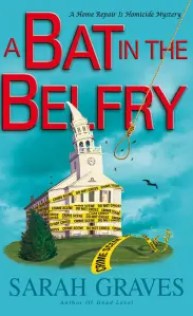
On the plus side, Jake has acquired a new, much better (!) husband, and her son Sam is finally sober (for now). Her best friend Ellie White is the kind of nice normal woman Jake aspires to be, but with a heart of pure don’t-mess-with-me. She’s surrounded by downeast Mainers even quirkier than she is, and — possibly as a result — over the years, Jake has mellowed.

Well, sort of.


Tagged , , , , , , , , , , , , , , , , , , , | 9 Comments

How I’m Spending My Summer Vacation

Already these little gals are so much bigger! Nearly 2 weeks old.

At the Bath Book Shop with Deb Frankel, former Camdenite.

Like many Mainers, we don’t go away during the summer.  In twenty-seven years, we’ve only done it once.  That’s because our jobs become busiest in the warmer months, and, since we are self-employed, taking off now would be nuts. (It’s one of the great ironies of living in Vacationland that most of its residents find it hard to take one!)

Vicki Doudera here. Despite the title of this blog, I’m not really taking a summer vacation, but I’ve decided to act like I am by embracing two beliefs:  one, summer is an attitude; and two, every day should have some work and play.  Toward that end, my days are a jumble of writing, real estate, walking the dog, riding my bike, and sailing.  How to fit it all in?

1. Rise early, Three times a week I’m cycling at 6 am with a few friends. It’s keeping me in shape and making my head feel good, too. The other mornings I take long rambles with the dog, noticing what’s newly bloomed, chatting with neighbors, or mulling over sections of my fiction.

2. Try something new. In addition to starting Darby Farr #5, I’m working on some short stories for my publisher. These are a challenge for me, but summer feels like the time to tackle new things. I take my laptop and write wherever I fancy — at the camp, on the porch, or on the deck. Being so portable is a welcome change from the rest of the year, when I’m positioned as close as possible to the woodstove.

3. Get to work in a fun fashion. Last summer I found an old “frosty blue” Schwinn Suburban bike from 1979. I cleaned it up, got new tires, and found a basket for the front. I use it to cruise downtown when I really must head into the office, and somehow it doesn’t feel like I’m trudging off to work.

4.  Do a summer project. Last year, it was the Schwinn, the year before, some old kitchen chairs that I gave new lfe to with spray paint and vinyl.  This year? Chickens!

Right now, four adorable chicks are chirping away in our barn. They’ll stay in there until August, when they’ll be big enough to go outside.  By that time, I’ll have sorted out their living quarters.  I think I have a coop lined up at a new listing in Lincolnville, but first I have to figure out how to get it to Camden.  It’s in rough shape, but I’m looking forward to fixing it up. (Another project!)

5. Mix n’ Match.  I’m doing lots of signings in various parts of Maine this July, and will be in Rockland today (2 to 3:30 pm at the Reading Corner) as you read this.  Although technically “working,” I approach these events as mini-respites. I browse the stores, people watch, and enjoy whichever town I’m in.

I’m not taking a summer vacation, but with a few tricks I can still enjoy this all-too-fleeting season. What about you?


Posted in Uncategorized | 4 Comments

THE WORRY GENE

I had a health scare this past week. No, I haven’t come down with some rare disease. I haven’t even acquired a new minor ailment. But what happened was pretty scary: I thought I’d lost my health insurance.

I inherited the worry gene from my mother. She could think of dozens of things that could go wrong on any given occasion. And with her it was always, “call me when you get there so I’ll know you’re all right.” She had high blood pressure for most of her life. Doctors used to warn her: “You’ll worry yourself to death if you don’t relax!” (She lived, by the way, to be 83)

Lucky me. Mom passed along her high blood pressure, her arthritis, and her worry gene.

source of my worry gene---my mom at about 66

When I leave home for an out-of-state conference, I’m always certain that A) the plane will crash and I’ll never make it back to Maine or B) the house will burn down while I’m gone. It doesn’t seem to matter than in umpty-zillion such trips absolutely nothing terrible has ever happened. My worst travel experience to date was being stuck in Newark in the middle of the night.

Anyway, getting back to the current cause for panic. There’s a certain irony at work here. One of the things I’ve always told new writers, only partly with tongue in cheek, is that to succeed in this business they need to acquire either a generous patron of the arts or a spouse with a “real” job and health insurance.

I’ve always had the latter. When my husband retired, I had to pick up the tab for 100% of my coverage, but at least I was still on the policy. I have lots of friends and family members who either have no health insurance or are underinsured, and they aren’t all self-employed writers, either. You get laid off, your health insurance ends. Oh, sure, they offer to sell you coverage, but since you are out of work, you can’t afford the premiums. Health insurance? Or food and rent or mortgage payments? Not a choice anyone should have to make.

So, flash forward to July 1, 2012, when the State of Maine switched insurance companies from Anthem to Aetna. I’d already talked to the good folks at Employee Health and Benefits when Anthem sent me a notice that my health insurance was about to expire. They assured me that as the spouse of a retired state employee who was herself still under retirement age, I’d automatically be switched to Aetna. But here’s the thing: when we received his retirement check on June 30, no health insurance deduction had been made. Oh oh! Add to that the fact that I had yet to receive a new insurance card in the mail and that it was by then the weekend, and I was in full-scale panic mode.

Think about it. Without any health insurance, how much would you have to pay for prescriptions? I’m pretty healthy overall,

me at 64, still reasonably healthy (knock wood!)

but I take three meds for the blood pressure, one for the arthritis, and another to control my thyroid. It adds up even with health insurance. My worry gene didn’t stop there, of course. What would a routine tests cost? My eyes are getting old along with the rest of me. I have regular check ups for potential problems with glaucoma, cataracts, and field of vision. Any writer is going to be terrified of vision problems. Then there’s the big stuff. Without health insurance, how on earth would you pay for an emergency operation, say an appendectomy? If one was necessary to save your life, would you then spend the rest of that life paying for it? I don’t know about you, but with health care costs as high as they are, it wouldn’t take much to completely deplete my savings.

I suppose the worry gene is related to the creative imagination. Dreaming up worse-case scenarios is what I do for a living. So naturally, visions danced through my head all weekend long—everything from broken bones to a heart attack to an allergic reaction to tripping over one of the cats and getting a concussion in the resulting fall. There were a couple of nightmares, too, but fortunately I can’t remember the details.

When Monday finally arrived, I used the Aetna number that came with the retirement check and went in search of answers. They cheerfully informed me, after asking for my social security number, that I was NOT in their computer. Oh, joy!

the one thing I didn't have to worry about---the paperback edition came out on July 3rd

I did think to ask if I was the only under-65-spouse-of-a-state-retiree-on-Medicare who’d been in touch with them with this problem. I was not.

Call number two was to Employee Health and Benefits (again!). I worked my way through a phone tree and left a voice mail message. It was late afternoon before I got a call back. Lots of time to worry. The nice lady on the other end assured me that I was still covered. She’d make a call and my insurance card would be sent right out. If I needed emergency care in the meantime, I could tell the hospital to call Aetna. The confusion there, apparently, was because I’m listed under my husband’s social security number, not mine. He’s the former state employee and therefore the one who is insured, although not by Aetna because retired employees are still with Anthem. (Don’t ask!) And what about the failure to deduct my insurance premium from hubby’s retirement check? Well, she wasn’t so sure about that. They’re checking into it. I shouldn’t worry.

Easy for her to say. Still I do, apparently, have health insurance. Did I receive my insurance card yet? Yes, on Thursday. Am I feeling more secure? More so than I was. But here’s the kicker. When I turn 65 and go on Medicare myself in a few months time, the state, in its infinite wisdom, will be switching me from Aetna back to Anthem for my supplemental insurance.

The worry gene is already poised to go into action.

Posted in Kaitlyn's Posts | Tagged , , , , | 6 Comments

One Morning in Maine

A quick post today that will serve as a reminder (to me as much as anyone) of why I write in Maine about Maine and have no inclination to do it anywhere else.

This came to me in the middle of a Q&A at a talk at the Auburn (Maine) Public Library this week. A reader brought up Waldo County, where many of my books are set, saying how fascinating the place was, that it was a sort of parallel universe. You step through a door in Jackson, Monroe, Thorndike and you enter another world.


Well, that got us to talking about Maine in general and how much we love that we live here. It was a nice reality check amid  the talk of crime and murders and gritty settings and scroungy characters in my books. Maine is a beautiful and special place.


I sometimes neglect to give Maine its due, at least not on this blog, which is about crime writing, after all. But the magic of Maine is why I’m here, why my characters are here, and they feel it, too. Jack McMorrow will never return to Manhattan from Prosperity, Maine. Brandon Blake will never leave his boat on Casco Bay.


We all have those “ahhh moments” when we are fortunate enough to come upon some beautiful corner of the state. Last week it was the east side of Penobscot Bay. One morning we took the boat down the Penobscot River from Bucksport, passing under the Verona Narrows bridge, that spectacular piece of sculpture that spans the river at Verona Island. We ran down the river and out into the bay, staying on the east side. The air was cool, the bay was calm and, that far north in the bay, there were few boats in sight. We motored past Castine, Holbrook Island, Harborside, and the head of Cape Rosier. On the south side of the cape, at the entrance to Eggemoggin Reach, the waters went calm, a rippling gray sheet broken by porpoises, arcing like shimmering black dancers.

This is Robert McCloskey’s turf, the setting for his wonderful books. One Morning in Maine, Blueberries for Sal, and all the rest. We slipped between the islands, Pond and Hog, with haze-shrouded Butter and Great Spruce Head in the distance, the locations of many picnics past for our family. Moving into the Reach, we passed the tip of Little Deer and continued east, checking out some haunts from years ago, when we spent a lot of time here.

Back to Buck’s Harbor, we stopped at Buck’s Harbor Marine for fuel, walked up to the store for sandwiches. The old Condon’s Garage, of McCloskey fame, was closed and dark. The sandwiches from the store were freshly made and we bought a bag full and took them with us. Outside of the harbor, we stopped and ate. More porpoises passed. Sailboats headed for the bay. We looked out on paradise.

And then we  rode the swells blown up by the afternoon wind, all the way back up the bay to the river.

A parallel universe, indeed. What is the special place in Maine that makes you feel the same?


Posted in Gerry's Posts, Uncategorized | Tagged , , , , , , , , , , , , , | 9 Comments

Happy Birthday to Us

Hi, it’s Kate Flora, here, on the 4th of July, realizing that in a few short days, Maine Crime Writers will celebrate our first birthday.

It’s been a wonderful year sharing thoughts and ideas, of asking questions about process, of discussing the different ways we approach our writing, richly interspersed with stories about Maine festivals, food, customs, quirks and crime. The particular beauty of blogging with a group is the hearing the different voices and thoughts, and the particular beauty of blogging with other writers is how eloquent and thoughtful those voices are.

I just went back and reread those first introductory columns and was reminded, once again, of what a richly diverse group of writers we are, and how lucky I am to belong to a blog group as talented and thoughtful as Maine Crime Writers.

As the organizer, I got to write the initial column, Maine Crime Writers enter the Blogosphere. It was a quick summary of who we are and why we decided to get together and celebrate our writing, and how living and working in Maine is especially important to us and influences the way we see and the things we write. My fellow bloggers followed to introduce themselves to you.

Leading off was Sarah Graves, who has now given us a whole year of insight into what it’s like to live and write way down east in Eastport. It’s worth it, if you’ve ever imagined living in REALLY rural Maine, to reread some of her posts, beginning with the lovely, “You Might Be a Maine Mystery Writer if…” you drive 300 miles to go to a signing.

Camden writer Vicki Doudera followed with, “Beautiful and Creepy,” focusing on Maiden Cliff in the Camden Hills State Park, where in 1864, Elinor French tumbled off while on a church picnic. Memories of that story were revived when a tourist from the midwest pushed his wife off the cliff, and then fell off himself. Maine is full of places that have stories, and crime writers do love stories.

Wilton writer Kaitlyn Dunnett, in a column titled, “I Kill for a Living” explains how she is actually three writers and has more than 40 books to her credit. As Kathy Lynn Emerson, she has written the Susanna Appleton mystery series, about a 16th century noblewoman and herbalist. As Kate Emerson, she writes historical novels, and as Kaitlyn Dunnett, she is the author of the Liss MacCrimmon Scottish-American heritage mysteries.

In his debut column, Gerry Boyle asks the question, “Is the Maine of our respective imaginations something you can find in real life?” After touring Portland with a videographer, working on a book trailer, he concludes that you can “take all of our Maines and ball them up and  you should get something may not be actual, but will ring true.

In “Fans,” Paul Doiron muses on the surprises and revelations of fan letters and comments, and how the stories people come to tell him are “like catnip” to his imagination.

Our own librarian, Hartland librarian John Clark, led off his monthly series of reviews of mysteries for young adults in a column titled, “Ah, Sweet Mysteries of Youth.” We’re very proud of John for reading all of the YA and middle grade books nominated for an Edgar this year, and picking the winner of both categories.

Like Gerry Boyle, James Hayman uses Portland as a setting, and he discusses the allure and importance of his choice to set his thrillers in Portland. Setting is present right from the start in The Cutting, the first line of which is, “Fog can be a sudden thing on the Maine coast.”

Boothbay Harbor writer Barb Ross tells the story of how her family came to be in Maine, when her mother-in-law, on a tootle down the coast, stopped at a B&B in Boothbay Harbor, and the next morning, learning that the place was for sale, decided to buy it and move there.

In “True Confessions,” Edgecomb writer Lea Wait describes how, like Kaitlyn Dunnett, she wears multiple writer’s hats, writing adult mysteries and historical fiction for readers 8-14. Then she related how, having spent her summers in Maine, she now lives here, and says, “I don’t remember when the smell of saltwater breezes didn’t remind me of home, and I every day I tell myself how lucky I am to live in this wonderful state.”

And our 10th member, Julia Spencer-Fleming, in “I Married Maine,” tells how she was courted by a fellow law student who drew her here repeatedly for visits, until they married and her visit became permanent.

It’s been a rich year of blogs about so many things Maine–Moxie, alewives, blueberries, our favorite restaurants and special places. We’ve talked about the challenges and excitement of being writers. We’ve discussed our doubts, the places we get stuck, and celebrated insights and breakthroughs, contracts and life changes. And you’ve been there with us.

Do you have a favorite column? A topic you’d like us to discuss? Join the conversation.

Leave a comment and you might win a copy of my Portland-based police procedural, Redemption.


Posted in Kate's Posts, Uncategorized | Tagged , , , , , , , , , , , , , , , , , , | 7 Comments

The British Are Coming! To Castine! by Julia Spencer-Fleming

Fourth of July Lobster. Yeah, I went there.

Tomorrow, we celebrate the day when the nascent United States of America declared its independence from Great Britain. (So far-sighted of our Founding Fathers to do it in July. Sure, they were sweating it out in wool coats back then, but generations of beach-going, picnic-toting, barbeque-throwing Americans are thankful the Continental Congress didn’t meet in February.)


However, I want to talk about a slightly later war between the United States and Britain – one that might have left every Mainer north of Waterville out of the fireworks-bespangled fun.

This year is the bicentennial of The War of 1812, mostly remembered in the US for two things: inspiring

Really, guys? Really?

Francis Scott Key to pen the poem that became the National Anthem, and Dolley Madison saving the Gilbert Stuart portrait of Washington from a burning White House. I don’t think many of my fellow citizens realize these events occurred because British ships were occupying American waters and British troops were kicking American keisters.

Dolley Madison was hands down the most kick-ass first lady of all time. She is ready to give you a beat down with the Declaration of Independence if you don't get out of her way.

It was, however, the United States which declared war on Britain, not the other way around. At the time, it was the equivalent of David declaring hostilities on Goliath – without a slingshot. The US had five frigates and a few thousand troops armed with obsolete weapons and doctrine. Britan was the greatest sea power in the world, and her vast armies, under the Duke of Wellington, were conquering Spain and moving towards Waterloo. (I learned this from watching SHARPE. Thanks, Sean Bean!)

If all the British looked like this, the Maine ladies probably welcomed them with open arms.


The western states and territories thought war was a fine idea. The states along the eastern seaboard – i.e., those within easy reach of British man-o-wars – though it was a terrible idea. After Congress declared war, the British proved them right by promptly seizing the entire Chesapeake Bay and putting our capitol city to the torch. They also locked up the vital shipbuilding harbor of New London, Connecticut, fought to a standstill in New Orleans, and – most dastardly of all – set their sights on Maine. Specifically, Castine, Maine.


The English seemed to have a thing for Castine. The city had been occupied during the Revolution, and when the tide turned in favor of the Patriots, Castine’s disgruntled Loyalists literally uprooted themselves, towing their houses behind their boats and founding the town of St. Andrews in New Brunswick. Mainers, ladies and gentlemen.

"Let's go, men of Maine! Get those scurvy Brits! In their much, much bigger ship!"

Perhaps some of the expatriates got the ear of Sir John Coape Sherbrooke, because in August, 1814 he left his base in Nova Scotia with a fleet of ships and 500 British grenadiers. It took them only 26 days to conquer Castine, Hampden, Machias and Bangor, giving the British absolute (and profitable) control over Penobscot Bay. The strike was fairly bloodless, although seventeen American ships were captured or destroyed. Ouch.

Today, the Penobscot region is valued for its beautiful wilderness areas and waterways, its outdoor recreation, and its picturesque seaside towns. Presumably, those were also around when Sir John and his troops landed; however, they were more

I hope you remember this if my son applies here, Canada.

interested in the rich merchant shipping and lumber trade streaming in and out of the bay. Most tourists to Vacationland go home with pine-scented sachets and a live lobster on ice; when the British left (after the 1814 Treaty of Ghent gave Maine back to the US) they took £10,750 in tariff fees they had collected during their eight month stay. That’s worth £7,130,000 today! What did they do with their ill-gotten loot? Took it back to Nova Scotia and used it to found Dalhousie University. Oh, Canada.


Nowadays we're all like, "C'mere and give me a bro hug, Great Britain." Then, not so much.

So be thankful, my fellow Mainers. If not for the hard work of those Ghentish diplomats, we’d all be sitting around eating poutine and watching the Stanley Cup Finals. Not a bad life, but I’ll stick with BBQ and baseball.


Posted in Julia's Posts | Tagged , , , , , , | 5 Comments

Influences: James Lee Burke

I don’t know if my fellow Maine Crime Writers are up for this game, but I’m curious to hear about the crime authors who inspired you to begin writing in this genre. Sometimes it’s not immediately apparent from a person’s novels which other authors had a profound impact on their creation. I’ve cited my affection for P.D. James before, but obviously I write nothing like Baroness James of Holland Park. I’ll get the ball rolling in the hope that someone else will pick it up.

Because I write about a Maine game warden, my books are often grouped with those of C.J. Box (who writes about a Wyoming warden) or with Nevada Barr (who writes about a National Park Service ranger). That’s exceedingly good company in which to find oneself, and I understand the “read-alike” thinking. Box, Barr, and I all write mysteries set in the outdoors, and we take great care to describe the natural with the same attention to detail that someone like James Ellroy brings to the naked city.

But if you asked which contemporary crime writer has influenced me the most, I would have to say James Lee Burke. I first encountered Burke in a college creative writing class. His short story, “The Convict,” appeared in the 1986 Best American Short Stories anthology edited by Raymond Carver, and I remember being blown away by the vividness of its descriptions. Burke published the story while the character of his great Cajun detective, Dave Robicheaux, was still taking shape in his imagination, but you can hear his signature style in the opening paragraph:

My father was a popular man in New Iberia, even though his ideas were different from most people’s and his attitudes were uncompromising. On Friday afternoons he and my mother and I would drive down the long yellow dirt road through the sugarcane fields until it became blacktop and followed the Bayou Teche into town, where my father would drop my mother off at Musemeche’s Produce Market and take me with him to the bar at the Frederic Hotel. The Frederic was a wonderful old place with slot machines and potted palms and marble columns in the lobby, and a gleaming mahogany and brass barroom that was cooled by long-bladed wooden fans. I always sat at a table with a bottle of Dr. Nut and a glass of ice and watched with fascination the drinking rituals of my father and his friends: the warm handshakes, the pats on the shoulder, the laughter that was genuine but never uncontrolled. In the summer, which seemed like the only season in south Louisiana, the men wore seersucker suits and straw hats, and the amber light in their glasses of whiskey with ice and their Havana cigars and Picayune cigarettes held between their ringed fingers made them seem everything gentlemen and my father’s friends should be.

Vivid descriptions and a nostalgic wistfulness are the hallmarks of Burke’s prose. All of his books, or at least the ones I’ve read, take place after a fall from grace. That prior Eden might have been an illusion in a child’s eyes, but the world seemed to have been a better place once, long ago. Modern America is downright hellish in Burke’s books: a pandemonium populated by an ever-expanding horde of physically, psychologically, and morally deformed characters. (The morally deformed ones are the worst and tend to belong to the upper levels of society.) Let’s just say that James Lee Burke takes a dim view of human nature.

Against these degenerates stands a deeply flawed but righteous man, Detective Dave Robicheaux. (Burke has several series going, but his other main protagonists, attorney Billy Bob Holland and his cousin Sheriff Hackberry Holland, seem like cuttings sliced from the same cypress.) Big-hearted but quick to anger, generous to a fault but brutally violent, Robicheaux is one of the great characters in contemporary literature. Like his creator, Dave is a practicing Catholic and a recovering alcoholic. In his eyes, human beings are self-wounding sinners, and he sees them with a clarity that only comes from having hit one too many bottoms. Here he is in A Stained White Radiance:

As a police officer it has been my experience that pedophiles are able to operate and stay functional over long periods of time and victimize scores, even hundreds, of children, because no one wants to believe his or her own intuitions about the symptoms in a perpetrator. We are repelled and sickened by the images that our minds suggest, and we hope against hope that problem is in reality simply one of misperceptions.

Systematic physical cruelty toward children belongs in the same shoebox. Nobody wants to deal with it. I cannot remember one occasion, in my entire life, when I saw one adult interfere in a public place with the mistreatment of a child at the hands of another adult.

Burke wrote those words in 1992, nearly two decades before the world ever heard the name Jerry Sandusky.

My wife and I talk about what we call “Dave Robicheaux moments” we have witnessed. If a pack of drunk men are catcalling girls on a corner, Dave doesn’t cross the street to avoid them. If a mother slaps her child in a supermarket parking lot, he doesn’t stand by gawking, as you or I might be inclined to do; he intervenes. Robicheaux is a man of action—often violent action—who steps into situations where the rest of us fear to tread.

If this all sounds unremittingly bleak, I am afraid it is. There are few moments of emotional uplift in a James Lee Burke novel. There are, however, many passages of gorgeous writing, usually focused on the natural world. Take this paragraph from the Edgar-winning Black Cherry Blues:

Late that afternoon the wind shifted out of the south and you could smell the wetlands and just a hint of salt in the air. Then a bank of thunderheads slid across the sky from the Gulf, tumbling across the sun like cannon smoke, and the light gathered in the oaks and cypress and willow trees and took a strange green cast as though you were looking at the world through water. It rained hard, dancing on the bayou and the lily pads in the shallows, clattering on my gallery and rabbit hutches, lighting the freshly plowed fields with a black sheen.

Now I’ve never been to Louisiana, but I can see that image so clearly in my mind’s eye that it reads like a memory. It’s the sort of powerful nature writing to which I aspire in my own books. If I can transport a reader to the Maine woods the way Burke brings us routinely to the bayous of Louisiana, I will consider my work well done.

Burke’s writing can get a little overripe at times (so could Chandler’s, though), and his plots seem to involve lots bad people showing up on Dave’s doorstep, or Dave showing up on theirs, for the purposes of exchanging threatening words with each other. Then there will be a shooting or a fistfight. At one point in the book, some scarred and haunted man will torture another scarred and haunted man in a desolate, windswept place.

But you don’t read a James Lee Burke novel to solve a puzzle-box mystery. You read if for the power of the prose and the strength of the characterizations, and for the way it returns you to a fully realized world that resembles the one we live in is so closely it forces you to take stock of your own moral and physical courage. Burke refuses to comfort or condescend to his readers, and that is what makes him great.

Posted in Paul's Posts, Uncategorized | Tagged , , , , , | 7 Comments