New Books Up for Pre-order

by Barb, who’s in Key West where it’s a chilly 63 degrees. The natives are in down vests and (even more shocking) sox!

December was busy with the holidays and the release of Steamed Open on December 18. Now I’m happy to announce two new books for the new year. Both are available for pre-order now.

Jane Darrowfield, Professional Busybody. Jane Darrowfield is a non-Clambake series book. It’s exclusive in paper from Barnes & Noble for the first year, then widely available in all formats after that. It’s a part of an experiment by B&N and Kensington. I realize this is not a boon to Mainers, since we only have one B&N (in Augusta–there’s one in Newington, NH, too.) But it is available from B&N online.

Jane Darrowfield, Professional Busybody

Jane Darrowfield is a year into her retirement, and she’s already traveled and planted a garden. She’s organized her photos, her recipes, and her spices.  The statistics suggest she has at least a few more decades ahead of her, so she better find something to do . . .

After Jane helps a friend with a sticky personal problem, word starts to spread around her bridge club—and then around all of West Cambridge, Massachusetts—that she’s the go-to person for situations that need discreet fixing. Soon she has her first paid assignment—the director of a 55-and-over condo community needs her to de-escalate hostilities among the residents. As Jane discovers after moving in for her undercover assignment, the mature set can be as immature as any high schoolers, and war is breaking out between cliques.

It seems she might make some progress—until one of the aging “popular kids” is bludgeoned to death with a golf club. And though the automatic sprinklers have washed away much of the evidence, Jane’s on course to find out whodunit.

It releases June 25, 2019 and is available for pre-order here.
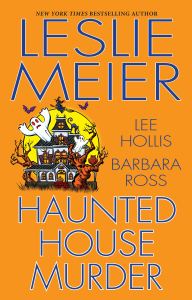
Haunted House Murder: I’m also excited about Haunted House Murder, the new novella collection by Leslie Meier, Lee Hollis and me. I love writing these holiday-themed novellas, all set in Maine, and I hope you enjoy reading them. This one is about Julia Snowden, her family and friends.

Haunted House Murder

Tricks and treats keep the Halloween spirit alive in coastal Maine. But this year the haunted house theme is getting carried a little too far . . .

HAUNTED HOUSE MURDER by LESLIE MEIER
Newcomers to Tinker’s Cove, Ty and Heather Moon have moved into a dilapidated house reputed to be a haven for ghosts. Now strange noises and flickering lights erupt from the house at all hours and neighborly relations are on edge. And when a local boy goes missing near the house, it’s up to Lucy Stone to unravel the mystery of the eccentric couple and their increasingly frightful behavior.

DEATH BY HAUNTED HOUSE by LEE HOLLIS
For the past two years, the house next door to Hayley Powell has sat abandoned after the owner died under mysterious circumstances. The Salinger family has recently taken possession of the property, but the realtor behind the deal has vanished—after a very public and angry argument with Damien Salinger. If Bar Harbor’s newest neighbors are murderers, Hayley will haunt them until they confess.

HALLOWED OUT by BARBARA ROSS
With its history of hauntings and ghost sightings, Busman’s Harbor is the perfect setting for Halloween festivities. But when a reenactment of a Prohibition-era gangster’s murder ends with a literal bang and a dead actor from New Jersey, Julia Snowden must identify a killer before she ends up sleeping with the fishes.

There’s nothing like home sweet home in this trio of Halloween tales . . .

This book is currently available for pre-order from all major retailers in hardcover and ebook formats. There will also be an audiobook version. Amazon*Barnes & Noble

I’m excited about these new books and can’t wait to share them with all of you.

Posted in Barb's Posts | Tagged , , , | 5 Comments

Veganuary Potato Leek Soup for a Snowy Sunday

As you may or may not know, January is known in some circles these days as “Veganuary” – a month when carnivores the world over attempt to give up meat for thirty-one long days. We already keep a mostly vegan household here so it’s not much of a stretch, but I thought I’d share a recipe for anyone who might already be immersed in Veganuary, or who would like to give it a shot.

I would love to say that these are my personal inventions, but I’m not there yet – I am still fully reliant on the brilliance of others for my kitchen adventures. In the following, I use this vegetable broth recipe by the Minimalist Baker, followed by a potato leek soup recipe in the cookbook Eat Like You Give a F*ckfrom Thug Kitchen.

thug kitchen

So, we start with the broth. I’ve been doing a lot of cooking lately, and about 60% of it has been soups. The rest has been bread, with the occasional dessert sprinkled in there. What I have discovered is that soup made from homemade broth has a depth of flavor that puts any bouillon cube to shame, and the boxed or canned broth isn’t much better. This takes a little bit of time, but veggie broth is easy to freeze and keeps for months. I try to do up a batch every couple of weekends, and freeze it in 2- or 4-cup portions in Mason jars. This broth by the Minimalist Baker is definitely the most flavorful vegan broth I’ve found.

VEGETABLE BROTH RECIPE
INGREDIENTS:

broth ingredients2

brothingredients1

1 T avocado or coconut oil
1 onion, skins and all, roughly chopped
4 cloves garlic, skins and all, roughly chopped
4 carrots, unpeeled, roughly chopped
4 stalks celery, roughly chopped
9 – 10 cups water
1 cup collard greens, including stems, roughly chopped
1/2 cup fresh parsley, roughly chopped
1 T dry rosemary
1 T dry thyme
2 bay leaves
4 T nutritional yeast
5 T tomato paste
1 t salt
1 t pepper

DIRECTIONS:

Heat oil in large stock pot. Once shining, add onion, garlic, carrots, celery, and 1/2 t of the salt. Let the veggies sweat for 5 – 6 minutes, until soft.

sweating veggies

Add water, collards, parsley, rosemary, thyme, bay leaves, the rest of the salt, and the pepper. Bring to a boil.

Once boiling, add nutritional yeast and tomato paste and lower heat to medium-low. Let the mix simmer on the stove for at least an hour.

After an hour or so, let the broth cool and then strain out the veggies. Freeze portions in Mason jars with at least an inch of head space and the top slightly loose to compensate for expansion.

POTATO-LEEK SOUP
INGREDIENTS

pl ingredients 1

1 T olive oil
1 lb golden potatoes, cubed and with skins on
3 medium-sized leeks, thoroughly washed and thinly sliced
3 garlic cloves, minced
4 cups vegetable broth
1 t salt + more to taste
1 t pepper + more to taste
1/2 cup scallions, chopped
1 t apple cider vinegar
Parsley for garnish

In a Dutch oven, heat oil until shimmering. Add leeks and let them sweat until softened, about 5 minutes.

sweating leeks

Add potatoes and garlic. Mix so that they have an even coating of the leeks and oil, then add broth, salt, and pepper. Bring to a boil.

Once boiling, lower heat to a simmer. Let the soup simmer for 15 – 20 minutes, or until potatoes are softened.

stew pot bubblin'

When the potatoes are soft, use immersion blender or (carefully) put mix in blender. Blend until you have the consistency you’re looking for – I prefer a more rustic mix, so tend to leave it a little bit chunky.

Return mix to Dutch oven (if you removed it to blender). Add scallions, and 1/2 to 1 t of apple cider vinegar, to taste.

Garnish with parsley and serve with bread. I made a homemade rosemary loaf yesterday that went beautifully with this.

final shot

So, that’s dinner. This particular recipe is admittedly short on protein, but if you’re concerned you could add silken tofu to the mix and it would make for an even creamier consistency, and would certainly up the protein quotient a bunch. If you’re doing that, just pay attention to your seasonings and adjust accordingly to make sure the tofu doesn’t make things bland.

Let me know if you do decide to give this recipe a try – I would love to hear how it turned out!

Jen Blood is the USA Today-bestselling author of the Erin Solomon Mysteries and the Flint K-9 Search and Rescue Mysteries. To learn more, visit http://www.jenblood.com. 

Posted in Jen's Posts | Tagged , , | 2 Comments

Weekend Update: January 19-20, 2019

Next week at Maine Crime Writers, there will be posts by Jen Blood (Monday), Barb Ross (Tuesday) Susan Vaughan (Wednesday) Sandra Neily (Thursday), and Maureen Milliken (Friday).

In the news department, here’s what’s happening with some of us who blog regularly at Maine Crime Writers:


An invitation to readers of this blog: Do you have news relating to Maine, Crime, or Writing? We’d love to hear from you. Just comment below to share.

And a reminder: If your library, school, or organization is looking for a speaker, we are often available to talk about the writing process, research, where we get our ideas, and other mysteries of the business. Contact Kate Flora

Posted in Sunday Updates | Tagged , , , , , | Leave a comment

Walking the Winter Beach, Redux

Dear MCW blog readers:  Sometimes I scroll back through old posts and come upon one that’s ripe for a re-run, and so it is with this March, 2017 post about our Sunday beach-walking ritual. Forecaster chatter this week is we’re on the brink of the annual polar vortex, and Sunday is predicted to be chilly indeed. So if you take this post as inspiration to head out on a beach walk of your own, don’t forget to pull on your long johns, grab your thickest mittens and maybe even bring along a facemask for the half of the walk when-inevitably-you’ll be marching into the wind’s sharp teeth.  Enjoy!

by Brenda Buchanan

Sunday afternoons lend themselves to rituals.

Leisurely drives to who knows where. Gathering around the table for dinner with family and friends.  Kicking back with the Sunday papers, funnies and all, at least at my house, where we’ve never stopped immersing ourselves in newsprint. Joe Gale and his real-life counterparts (including three generations of Millikens) are our heroes.

Our central ritual is the Sunday afternoon beach walk, which happens year-round but is especially wonderful in the winter.  There’s nothing like a bundled-up exploration of what the tide has wrought to re-charge a girl for the week ahead.

For readers of this blog who don’t live near enough to a Maine beach to walk regularly in the cold-weather months, here are some favorite photos to get you through until spring.

Some weeks the beach is drenched in sunshine.

And sometimes skies are gray.

More frequently than you might believe, the weather changes in the course of our walk.

Last Sunday the wind was howling at Pine Point Beach, transforming the waves into wild ponies.

Yesterday I found this lobster trap, marooned in the dunes.

Sometimes we’re entertained by intrepid surfers.


And sometimes we entertain ourselves.

No two weeks are the same, on the beach as in life.

I can’t say I’m ever bored when propelling myself through the wind along the wrack line. When I can’t sleep, I sometimes try to conjure the sound of the waves hitting the shore, especially the winter beach, when stones tumble against each other at the verge, tapping in a rhythm that soothes my soul.

We typically stick close to home—Scarborough and Ferry beaches near Prout’s Neck, Pine Point when the wind and tide are right, Crescent Beach in Cape Elizabeth when we want to approach the shore from the woods.

Occasionally we wander up the coast to Popham or Reid State Park.

Something always provides a nudge of inspiration for a story.

Do you have Sunday rituals? Or favorite beaches?

Brenda Buchanan is the author of the Joe Gale Mystery Series, featuring a diehard Maine newspaper reporter who covers the crime and courts beat. Three books—QUICK PIVOT, COVER STORY and TRUTH BEAT—are available wherever ebooks are sold.

Posted in Brenda's Posts | Tagged , , , , | 4 Comments

The New Year Is Off To A Great Start

It’s only January 17 in the year 2019 and I’m feeling that this year will have a lot in store for we writers.

Vaughn

First: I was invited to be a participant in Guys and Goals, a forum for gifted fifth and sixth grade boys. I was contacted by Jamie Pelletier who invited me to participate as a presenter. She told me that she was seeking adult men who would be positive role models for sixty young Aroostook County men who were at or near the top of their classes. First of all I want to be clear that never before have I been considered a positive role model! However, when I asked Jamie what would be expected of me she informed me that I would do four thirty minute presentations each to a group of fifteen students. The presentation was to be about my life and how I became a writer.

I started the presentation with an introduction giving the basics of my life, stating my being a local boy, my educational background, and a brief employment overview. I then asked if any of them were considering becoming writers. I was pleasantly surprised when there was at least one (or more) students in each group that raised their hands. I followed up asking if they were writing now. They all were. What followed was an enjoyable morning in which I hope motivated them to write–it motivated me.

The second positive was the influence we members of the MWPA are gaining in Maine. The Portland Press Herald decided to no longer publish reviews of books written by local (Maine) writers ( https://www.publishersweekly.com/pw/by-topic/industry-news/publisher-news/article/79001-mwpa-saves-local-book-reviews-with-boost-from-stephen-king.html). Joshua Bodwell learned of this and started an online petition campaign. In two days the campaign (see link above) had increased online subscriptions and the paper relented–they will continue to publish reviews.

All of the above in a little over two weeks! As a result I have become re-energized (don’t expect me to wear a pink bunny suit and pound a drum, however) and have decreed that in the upcoming year I am going to become proficient in that part of our business that I hate the most–marketing my books! The first marketing activity is to remind everyone that my fifth novel (second in the Ed Traynor series) is slated for release on July 2 (already available for preorder–hint, hint). My first reader has gone on record as saying that it’s my best yet. The premise is: What would you do if you were summoned to a remote woods land to I.D. a body and it turned out to be your brother–with whom you’ve had a stormy relationship for years?

Well, time for me to get busy. Part of my campaign is to begin doing podcasts and I need to iron out some wrinkles. The primary wrinkle is “what to podcast about?” Any ideas?

Posted in Uncategorized, Vaughn's Posts | Tagged , , , | 1 Comment

A Wintry Mix – Of Words

 Kate Flora: Oops! There I was, settling in to watch Episode Two of the new True img_2167Detective when suddenly my iPad went “ding!” and there was the reminder. Blog for MCW tomorrow. Thought I’d done that. It was definitely on the list. The list that’s here somewhere, buried under a million other tiny pieces of paper. “Gotta go write a blog post” I tell my husband. “You know what you’re going to write?” he asks. “Absolutely no idea.”

Things don’t get better when I’m at my desk, staring at the blank white page. Nor when I rustle around the room, looking for a handful of reference books.

Well, heck, I think, maybe I can recycle some old thing. But when I find that old thing, it only reminds me that it isn’t suitable. So I dig out my trusty Rodale’s Synonym Finder (a book no writer can be without) and begin to read.

I am looking for the word “Winter.” It isn’t here. Happily, I find “Wintry.” It leads me to delicious choices like hibernal. Hiemal. Brumal. Cold. Frigid. Freezing. Ice-cold. Shiveringly cold. Icy. Frosty, snowy, arctic, glacial or hyperboreal. Then on to Siberian, inclement, stormy, blizzardly, windy, bitter, nippy, sharp, piercing, biting, cutting, brisk, severe, rigorous, hard, and cruel.

Does this make you want to pick up your pen? Are you a writer like me, who loves lists of words? Who thinks it would be fun to create a character who actually uses the word “hyperboreal?”

img_1813If I read on, the book offers me some lovely dark words for a crime writer, particularly one who is writing during the dark months in a cold New England landscape. Here are some tasty words to sample over your morning coffee: bleak, desolate, stark, cheerless, gloomy, dismal, dreary, depressing, unpromising, somber, melancholy. How about dark, gray, overcast, sullen, or lowering? These words pretty well fit the woods behind my house, which are shades of brown and gray and have been since the leaves fell back in November.

When I go looking for “hibernal,” it isn’t there, but “hibernate” pops up at me, the perfect thing to during the month of January. Hibernate leads to: lie dormant, lie idle, lie fallow, stagnate, vegetate, and estivate. Perhaps more fitting, for those of us who find these winter months perfect for sitting at our desks and listening to the voices in our heads, there are these: withdraw, retire, seclude oneself, go into hiding, lie snug, lie close, hide out, hole up, sit tight.

I am pretty much holed up, lying snug, and secluded. But I love the almost song-like rhythm of:

hide out

Hole up

Sit tight.

Which leads me, since playing in dictionaries and Thesauruses is part of a writer’s fun, to fullsizeoutput_1640the far more positive word: snug. Try these lovely words on for size: cozy, intimate, comfortable, easeful, restful, relaxing, quiet, peaceful, tranquil, serene, informal, casual, warm, friendly, inviting.

I am reminded of the snug in an English bar. Snug also suggests secret, private, covert, secluded, well-hidden, screened off.

So while you are reading this, I am secluded, screened off, and well-hidden at my desk, a space which is cozy, warm, and inviting. And once the screen is up and the manuscript is open, I shall turn my back on the hibernal, bleak, stark, cheerless landscape outside.

Hide out

Hole up

Sit tight.

And probably proceed to kill someone, or at least put them in serious jeopardy.

What are you doing on this dark and somber day?

p.s. Evidence of my long-time fascination with words are these three sheets of paper, found while cleaning out a drawer this morning. They were efforts to expand the boys’ vocabularies.

img_0563img_0562img_0560

Posted in Kate's Posts | 9 Comments

Going Back Home

What do think when you return to your hometown? Does it make you happy? Sad? Did you grow up in a big city or a small town? For many of us, it brings conflicted emotions, especially if we have family members still living there.

I only pose these questions because they loom large in many of my novels. In my newest book, PRAY FOR THE GIRL (due out 5/30/2019), Lucy Abbott returns to her small Maine town after fifteen years in Manhattan only to discover that an Afghani girl had been stoned to death. Not only does this complicate her relationship to her friends and family, but the death of the girl changes her relationship to the small town she grew up in. It’s not the same place she left. Nor is she the same person.

Surprisingly, I did not grow up in a small town, even though most of my books take place in small towns. There’s something about returning home that intrigues me, especially how old acquaintances perceive you after many years away. What are the bullies and jocks like now? The pretty girls and the class clowns? People change and it’s interesting to see if they changed for the better or for worse. Some even end up behind bars. One of the worst, most pathetic wrestlers on the wrestling team in my hometown went on to become a big MMA star.

Gillian Flynn portrays these small towns wonderfully in SHARP OBJECTS. Camille returns home to write a report on a murder. But she has her own secrets to hide. Her interaction with her town seems fraught with danger and peril. Her mother proves to be a monster like no other. If you haven’t read this book than I suggest you do.

Many people hate returning home on account that they experienced a bad childhood or had a rough time in school. Others enjoy going home. Some never leave. I feel ambivalent about returning to my hometown because of some events that have happened. There was certainly good time, and certainly many bad times too. I still return every now and then, since it’s near Boston. But will I return when there’s no one left? How do you feel about going home?

I do, however, enjoy writing about it. Maybe it’s my complicated feelings about the matter that make it a fruitful topic for my novels. Add in the element of crime and it becomes so much more intriguing. In PRAY FOR THE GIRL, Lucy mud navigate a class bully as well as a love interest that wants to renew their teenage relationship—after fifteen years have passed. Complicating matters is a dying diner and the influx of Afghani immigrants that have moved into Fawn Grove, not to mention a dead Muslim girl.

So, tell me how you feel about returning to your hometown. In the meantime, make sure you preorder your copy of PRAY FOR THE GIRL and see how Lucy deals with her return to Fawn Grove, Maine.

EC552EB4-3718-4869-AD5C-BC5E5FD38C23


Posted in Uncategorized | 1 Comment

The Fine Line Between Saving and Hoarding

Kaitlyn Dunnett/Kathy Lynn Emerson here, once again doing some weeding.

This past week, when I was moving last year’s file folders to make room for new ones for 2019 receipts, I realized that every single one of the places I file stuff was overflowing, even the file cabinet in my husband’s office. I need to keep some of those files for tax purposes, but for quite a while, I’ve been meaning to weed out research notes I no longer need. This appeared to be a sign that the time was now.

So, I started pulling files. When I managed to create a gap, I moved other files to the empty space. But then, inevitably, I began to see that some of the files I was shifting into the holes needed weeding, too.

Here’s the thing. I have always had a basic distrust of electronic storage of information. Computers crash. The Cloud isn’t all that reliable, either. I back up on multiple devices. I also print every email I think I may need to refer to later. If I suspect there’s a reason to keep a paper copy, I make one. I have file folders of email correspondence with my agent, with each of my publishers, past and present, and with readers (separated by pseudonym with a separate file for correspondence about my A Who’s Who of Tudor Women). I have files for promotion for each of my books, and files on books and short stories that didn’t sell (there are plenty of those, believe me!) going back to when I got serious about being a writer in the mid-1970s.

Since I’ve started this project, I’m determined to do it right, but it’s going to take much longer than I anticipated. I have to go through each folder to make sure I don’t accidentally throw away something I need. Of course the reason I created the folder in the first place was because I thought I might use the contents someday.

When, exactly, does saving become hoarding? I’ve had an article on jade, cut out of an old National Geographic, for decades. It has gorgeous pictures, but I’ve never used the material in a book or story. Yes, there’s a chance that I’ll have an idea in the future and wish I’d kept that piece, but if I do, I can find it again. That one goes in the trash.

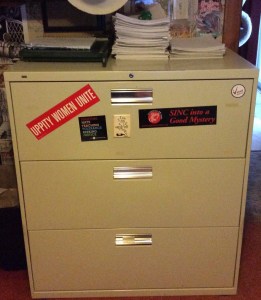
file drawer I haven’t yet dared open

Most of the sixteenth-century material in my research folders has already been used in published books. I’m not likely to use it again. I try never to say never, but right now it seems to me that I’ve done all I want to do with fiction set in that era, especially since I have one book already written that hasn’t yet found a publisher. I’m even more certain I won’t write more books set in 1888, so there’s no point in hanging on to all that nineteenth-century research.

I love maps, but do I really need to keep dozens of them showing New England and New York in the seventeenth-century? I set one romance novel and one juvenile historical (that never sold) in colonial New England. Lots of other historical maps need to go, too. I really can’t think why I’d need one of medieval trade routes, and that’s just one example.

I am finding hidden gems in some files, including lots of postcards, mostly acquired on research trips. I’m not sure what I’m going to do with those. Who sends postcards anymore? Photos I took on those same research trips will go back into my scrapbooks. Ditto some promotional material. I’m also keeping early rejection letters. I’m not sure why. But what about printouts of manuscripts in dot matrix that were never published because an imprint folded? Is it saving to keep those, or hoarding? If I don’t toss them now, there will only be that much more junk for my eventual heirs to get rid of. And what about printouts of all the posts I’ve written, not just for Maine Crime Writers, but for other blogs when a new book was about to come out? They exist online, supposedly forever. Do I really need to take up space with paper copies?

Speaking of paper, there is one bonus to come out of this wholesale weeding. Lots and lots of pages in these discarded files are blank on one side—perfect for printing up various drafts of my work in progress. I’ll recycle them after both sides have been used and I’ve moved on to the final draft.

As the saying goes, pictures are worth a thousand words, so I’m illustrating this post with shots of the weeding project in progress. I hope you’ll share some of your own experiences with downsizing in the comments section, and wish me luck as I continue to search for the fine line between saving and hoarding.

Kathy Lynn Emerson/Kaitlyn Dunnett is the author of nearly sixty traditionally published books written under several names. She won the Agatha Award and was an Anthony and Macavity finalist for best mystery nonfiction of 2008 for How to Write Killer Historical Mysteries and was an Agatha Award finalist in 2015 in the best mystery short story category. She was the Malice Domestic Guest of Honor in 2014. Currently she writes the contemporary Liss MacCrimmon Mysteries (Overkilt) and the “Deadly Edits” series (Crime & Punctuation) as Kaitlyn and the historical Mistress Jaffrey Mysteries (Murder in a Cornish Alehouse) as Kathy. The latter series is a spin-off from her earlier “Face Down” mysteries and is set in Elizabethan England. Her most recent collection of short stories is Different Times, Different Crimes. Her websites are www.KaitlynDunnett.com and www.KathyLynnEmerson.com and she maintains a website about women who lived in England between 1485 and 1603 at www.TudorWomen.com

Posted in Kaitlyn's Posts | Tagged , , , , , | 12 Comments

Weekend Update: January 12-13, 2019

Next week at Maine Crime Writers, there will be posts by Kaitlyn Dunnett/Kathy Lynn Emerson (Monday), Joe Souza (Tuesday) Kate Flora (Wednesday) Vaughn Hardacker (Thursday), and Brenda Buchanan (Friday).

In the news department, here’s what’s happening with some of us who blog regularly at Maine Crime Writers:

Lea Wait: Sunday, January 13, Lea will be interviewed about her THREAD HERRINGS by Harry Rinker on WHATCHA GOT? his nationally syndicated antiques and collectibles call-in radio show between  8:30 and 8:45 ET. To find out where the show airs in your area, check Harry’s website (www.harryrinker.com) The show also streams live at genlive.com – click on “Listen to Talk.”


Bruce Robert Coffin: Thursday, January 24th, Bruce will be interviewed by Frank O Smith from 6 – 7:00 pm in the Eleanor Conant Saunders Reading Room at the Walker Memorial Library in Westbrook. For more information: walkerlibrary.org


The Portland Press Herald/Maine Sunday Telegram 
has announced while they will continue to run national book reviews obtained from wire services, they will no longer run reviews of books by freelance reviewers about Maine, set in Maine, or by Maine authors. Maine authors, bookstores, and readers depend on these reviews. While this is a national trend, it’s a shame to see it happen in a state so rich in readers and writers. There’s a petition up at change.org if you’d like to sign it here.

Update: The Portland Press Herald says it will reinstate local reviews if 100 people buy a digital subscription using the promo code CARRIE. You can subscribe here.

Updated Update: The numbers are in. Freelance reviews survive. After tweet from Stephen King, readers respond to Press Herald pitch


An invitation to readers of this blog: Do you have news relating to Maine, Crime, or Writing? We’d love to hear from you. Just comment below to share.

And a reminder: If your library, school, or organization is looking for a speaker, we are often available to talk about the writing process, research, where we get our ideas, and other mysteries of the business. Contact Kate Flora

Posted in Sunday Updates | Tagged , , , , , , , , , , | 3 Comments

Working from home

A friend told me recently that her brother, who lives in what we around here think of as (The Other) Portland, is spending a month in Maine with their father to help him through some medical problems.  “Of course,” she said, “he can do that.  He works from home.

We hear that phrase so often these days because so many people seem to be locked in their basements, hunched over their computers, trying to write the killer App that will bring them the big financial payoff that will make it possible for them to never work again, at home or elsewhere.  It’s a particularly interesting phrase for writers since the vast majority work from home, but the implications of it are worth considering.

In the first few decades of the 19th century, the industrial revolution created for the first time in the West a clear barrier between work and home.  Before then, almost all work was performed in and around the home, but factories and cities soon became the locus of work, leaving home as an alternative or contrast, the opposite of work.  This same dynamic gave rise to the gendering of work and home that led to an identification of home with women, but that’s a story for another time.

Now in the 21st century we seem to be revisiting the work-home dichotomy, in fact collapsing the wall between them.  But what remains is the sense that home is somehow better than work, a more desirable place to be.  I know many academics who complain that they simply can’t do any serious work at the office.  When I was an academic administrator I used to block off a day or so a month to vacate my office and instruct my secretary to tell anyone seeking me out that I was working at home that day.  The appeal is obvious:  casual clothes, a symphony playing on the radio in the background, unlimited access to coffee—and no pesky folks to distract you.

For writers, there is rarely an alternative.  John Updike rented a room over a commercial building in Ipswich, Massachusetts, to which he retreated daily to turn out the vast amount of prose and poetry that made him financially successful—and thus able to rent the space.  Other writers report that they like the routine created by having a writing space in a building separate from home.  They “go to work,” signaling to themselves that it’s time to get serious.  But for most writers, working from home isn’t a choice.  And it does have many rewards.  But is working where the rest of your life happens always the best approach?

I recall vividly the year I had a sabbatical from my faculty position at Ohio State when I was trying to write a book (on domesticity in 19th-century America, as it happens).  My son was two years old, determined to avoid naps, and always eager to play with Dad.  I did get some work done, but it was often frustrating because it forced me to choose between writing and fathering.  Fathering usually won, and that particular book never got written.  My son is now long out of the house, and my wife has a study far removed from where I work, but there are times when household chores provide distractions too hard to resist:  the laundry does have to be done, the woodstove tended, a pot of soup on the stove in need of a stir.  Writers of course are very, very practiced at finding excuses, perfectly reasonable arguments to turn away from the keyboard.  Would one be a steadier, more consistent writer working out of a space away from home?  Some would no doubt.  I’m not sure if on balance I would, but I’m unlikely to test the proposition.

The point here is that working from home, as common as it has become for many workers in addition to writers, may be a concept worth pondering a bit more closely than when we make the automatic assumption that those who do it are, as my friend implied about her brother, enjoying an especially blessed status.  Writers, what do you think?  Are you happy working from home?  Do the distractions of home sometimes make you yearn for a rented office elsewhere?  Or does where you write really not matter?

Posted in Uncategorized | 7 Comments