
When the Fluttery Muse Doesn’t Arrive

Kate Flora: Over the years, I’ve talked with a lot of people who want to write but can’t seem to sit down and do it. Or can’t finish that book. Or dream of writing but don’t have any idea what to write. Or were so wounded by a teacher or a series of rejections that they’re too discouraged to try again. It’s a hard truth that those of us in the trenches all face: writing is hard. Yes, there are days when the words flow so fast our typing can’t keep up. There are moments in the zone when the experience is almost ecstatic. But most of the time, even though we love it, writing is hard.

So what’s this about the fluttery Muse, you ask? I often complain about those who don’t treat writing as a discipline and say they only write when inspiration hits them. I believe that the working write goes to the keyboard, or the pad of paper, regularly and not only when inspiration arrives. This honors our desire to write and strengthens our writing muscles. But maybe there is something to the notion that having a muse to call on can be valuable. Maybe it would be a good idea to begin our writing sessions with an invocation to a muse, or for inspiration.

Here is the end of Homer’s invocation to the muses from the Odyssey:

Make the tale live for us
In all its many bearings,
O Muse
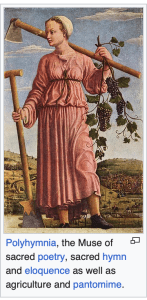
Whether it’s an inspiring invocation, or a comforting one, a ritual to begin the writing process might be a good way to enter into the mindset for writing.

Here’s one from Teddy Roosevelt:

The credit belongs to the man who is actually in the arena, whose face is marred by dust and sweat and blood; who strives valiantly; who errs, who comes short again and again, because there is no effort without error and shortcoming; but who does actually strive to do the deeds; who knows great enthusiasms, the great devotions; who spends himself in a worthy cause; who at the best knows, in the end, the triumph of high achievement, and who at the worst, if he fails, at least fails while daring greatly, so that his place shall never be with those cold and timid souls who neither know victory nor defeat.

Or perhaps you need simple encouragement, and this, from Shel Silverstein, might help:

If you are a dreamer, come in,
If you are a dreamer, a wisher, a liar,
A hoper, a pray-er, a magic bean buyer . . .
If you’re a pretender, come sit by my fire
For we have some flax-golden tales to spin.
Come in!
Come in!

Anne Lamont, in Bird by Birdreminds us that it is okay to write, as she puts it, “shitty first drafts.” So perhaps you own invocation will be a request to be allowed to write that awful draft. Or one to quiet the critical voices in your head. Or an invocation to remain undisturbed or to let your creativity flow without censorship. Perhaps your invocation will be a call to wake up your imagination or to have faith in your right to be creative.

When I was researching for this post, I found a very interesting school exercise where students were given the long version of Homer’s invocation and then guided to write their own. True, this makes the post too long, but I’m sharing it anyway. Who knows. Maybe this will inspire your own personal invocation.

Write Your Own Invocation!
Invocation – a convention of classical literature and of epics in particular, in which an appeal for aid (especially for inspiration) is made to a muse or deity, usually at or near the beginning of the work. The word is from the Latin invocatio, meaning “to summon” or “ to call upon.”

Homer’s Odyssey, for instance, begins:
Tell me, Muse, of the man of many ways, who was driven
far journeys, after he had sacked Troy’s sacred citadel.
Many were they whose cities he saw, whose minds he learned of,
many the pains he suffered in his spirit on the wide sea,
struggling for his own life and the homecoming of his companions.
* The traditional Muse of epic poetry is Calliope, although Homer does not address her by name in his invocation at the beginning of the Odyssey.

Student example:
Tell me, Muse about the man of many miles,
Who many times dashed as he ran through the streets
of Santa Monica.
He saw the Fatigue of his teammates and knew their pain.
On the course, he too suffered great pains within his lungs,
Yearning for the finish line, and his teammates’ success.
He could not guide his team to victory, though he wanted to:
His teammates had lost the race because of their laziness.
The slackers had disregarded the wise words
Of the well-traveled coach Cady, who knew the path to victory.
Tell the tale for us, beginning with the previous day,
Sometime after the piercing bell had sounded.
When all the others, seeking refuge from the torments of school
Had fled, light-footed to the safety of their homes.
Yet he alone, longing for the final mile and his own return,
Was confined by sound-minded Coach Cady, who strives for excellence,
To the fenced-in, crimson rubber surface that was his training
ground.

Now, create your own invocation (describing YOU).

Step 1: Play with epithets. A strict band director could be labeled “time-beating Sakow.” A popular cross-country coach “flat-footed Coach Cady,” A nagging mother “shrill-voiced Leona.” Play with Homer’s language. Imitate the first sixteen lines of The Odyssey by imagining that this is the opening to an epic about your life. How might your rhapsode begin?
Now write your own:
Call upon a deity / identify him / her by writing an epithet describing him / her
Call to the Muse next by first praising him / her, then by asking him / her to aid you in the writing of your invocation
Now describe who the story will be told about (YOU) using an epithet:

Finally, fill out the poem by writing a brief summary of your life story, or what makes you who you are – remember not to use complete sentences, play instead with epithets, similes, figurative language, etc so that it is in poetic form!

And excuse the language here, but yeah, it’s all about not letting anything get in your way:


Yes, friends, it’s back: Our “Where Would You Put the Body?” contest

It’s Maine Crime Writers “Where Would You Put the Body?” contest – late summer/early fall edition. How do you enter? Send a photograph of your chosen spot to: WritingAboutCrime@gmail.com with “Where Would You Put the Body?” in the subject line. There will be prizes for First, Second, and Third place–books of course and other Maine goodies. You may enter no more than three photographs, each one entered separately. They must be of Maine places and you must identify the place in your submission. Photos must be the submitter’s original work. Contest will run through the middle of October.


Posted in Kate's Posts | 3 Comments

Death of an Intelligence Gatherer

Kathy Lynn Emerson here. Brace yourselves. This is another one of my long book-origin stories.

As I’ve mentioned here before, I believe in recycling. If an idea doesn’t work for one book or short story, I’m likely to end up using it somewhere else at a later date. More often than not, the first incarnation was just a bad fit and the eventual metamorphosis is what it was meant to be all along.

the daughters of Sir Anthony Cooke

My very first attempt at writing a novel, begun in September 1976 and “finished” in February 1977, was based on the life of one of the daughters of a sixteenth-century courtier, Sir Anthony Cooke. It was titled, not very originally, One of the Daughters. He had five of them, and following the example of Sir Thomas More, educated them as if they were sons. One daughter died as a young woman. The other four were prominent in Elizabethan England, both as the wives of important men and in their own right. My focus was on Katherine, who may or may not have gone into exile on the Continent with her father during the reign of Mary Tudor, the queen who restored Catholicism to England from 1554-1558 and persecuted those Protestants who refused to convert. This tome, written in third person and totaling 562 pages typed on a manual typewriter, followed the tradition of Anya Seton and other writers I admired way back then and took the reader through her entire life. If I were reading it now, I’d rate it as boring . . . if I still had the manuscript. Mercifully, along with most of my earliest efforts, it no longer exists, in part because it morphed, through several stages, into what will be published on August 9 as Death of an Intelligence Gatherer.

That first attempt garnered six rejections (this was back when you could still send manuscripts to publishers’ slush piles) before I moved on to something else, but in 1982, after I’d begun to write for younger readers, I rewrote it, with a shorter time frame, as a young adult mystery titled The Die is Cast. The main characters was a well-educated girl in her late teens, Cordell Shelby, who travels with her father, Sir Anthony Shelby, into exile in Strasbourg, at that time a free city between French and German states. It came in at 49,000 words. I queried twenty-five publishers from 1982-1985 (yes, there really were that many back then) but no one was interested.

In 1987, I tackled the story again, this time thinking of it in terms of a first chronicle in a “Lady Allington” mystery series, since Cordell marries a young man  named Roger Allington in The Die is Cast. I kept that title, but now the characters were older and there was a spy subplot I borrowed from another early novel that had failed to sell. I worked on it on and off until I had a 71,000 word draft in July of 1989. By then I had an agent, but she couldn’t sell it either.

Fast forward to May of the following year at a mystery conference where I was chatting with an editor I’d worked with on my young adult novels. It turned out she’d briefly been an assistant editor at one of the houses where my agent had sent The Die is Cast. She’d wanted to buy it but been overruled. Now she was an acquiring editor for Harper Paperbacks, buying romance novels. She asked me if the book was still available and when I said it was, she suggested that I expand it to 100,000 words and beef up the romance angle between Cordell and Roger, making it possible for her to publish it as historical romance. I did (in fact the version I sent her ran to 117,000 words), and she did, and at 104,750 words it was published as Winter Tapestry in 1991. It was my seventh published book.

Now the story becomes two-tracked. Instead of the Lady Allington Mysteries, I created the Lady Appleton series. Although as well educated as Cordell, Susanna Appleton never went into exile, but she did help Protestants escape Mary Tudor’s England. Her husband, Robert, was vastly different from Cordell’s Roger—a villain, in fact. But yes, there are still a lot of similarities. Face Down in the Marrow-Bone Pie was published in 1997, the first of ten Face Down novels and numerous short stories.

In 1999, rights to Winter Tapestry reverted to me. E-books were still in their early days but I saw the potential. I retyped the book, adding back some material that had been cut and making a few other changes. In January 2003, the 95,602 word e-book version was released. It is still available at all the usual e-book outlets.

And now we come to the part I’ve written about before. It was just about a year ago that I decided to create an omnibus e-book edition of the three historical romantic suspense novels Harper published back in the 1990s. I started proofreading Winter Tapestry, planning to tweak it a little and eliminate the overuse of words like ’tis and ’twas, but the more I read, the more I realized that I wasn’t happy with it.

As published, Winter Tapestry contained multiple point-of-view characters and jumped back and forth between the romance, the murder of Cordell’s father, and a subplot involving spies. It isn’t a bad book, but I kept thinking of ways it could be better. For one thing, it had started life as a murder mystery. It ended up being published, according to the cover copy, as “a romantic adventure in Tudor England.” I really, really wanted to take it back to its roots. Then, too, there’s the fact that I’m a much better writer now than I was all those years ago. And I’ve developed a preference for using a single narrator. The “new” novel is written entirely in Cordell’s point of view.

On August 9, Death of an Intelligence Gatherer (now 73,933 words) will be released in trade paperback and e-book formats. Cordell Shelby is now Cordell Ingram. Some other character names have been changed as well, for various reasons. Roger’s has not, in part because a much older Roger Allington plays a small but important role in Face Down O’er the Border. He and Cordell are also mentioned in other Face Down novels.

So there you have it, the long tangled origin story. Hypothetical question: if you had read Winter Tapestry years ago, would you still be interested in reading this new version?

Kathy Lynn Emerson/Kaitlyn Dunnett has had sixty-four books traditionally published and has self published others, including several children’s books. She won the Agatha Award and was an Anthony and Macavity finalist for best mystery nonfiction of 2008 for How to Write Killer Historical Mysteries and was an Agatha Award finalist in 2015 in the best mystery short story category. In 2023 she won the Lea Wait Award for “excellence and achievement” as a Maine writer from the Maine Writers and Publishers Alliance. She was the Malice Domestic Guest of Honor in 2014. She is currently working on creating new omnibus e-book editions of her backlist titles. She maintains websites at www.KaitlynDunnett.com and www.KathyLynnEmerson.com.

Posted in Kaitlyn's Posts | Tagged , , , , | 9 Comments

Weekend Update: July 29-30, 2023

Next week at Maine Crime Writers there will be posts by Kathy Lynn Emerson/Kaitlyn Dunnett (Tuesday), Kate Flora (Thursday), and Brenda Buchanan (Friday).

In the news department, here’s what’s happening with some of us who blog regularly at Maine Crime Writers:

Yes, friends, it’s back: Our “Where Would You Put the Body?” contest

It’s Maine Crime Writers “Where Would You Put the Body?” contest – late summer/early fall edition. How do you enter? Send a photograph of your chosen spot to: WritingAboutCrime@gmail.com with “Where Would You Put the Body?” in the subject line. There will be prizes for First, Second, and Third place–books of course and other Maine goodies. You may enter no more than three photographs, each one entered separately. They must be of Maine places and you must identify the place in your submission. Photos must be the submitter’s original work. Contest will run through the middle of October.

 Matt Cost will be signing books at Sherman’s Maine Coast Bookshop in Portland on Saturday, July 29th, from 1-3 p.m. Cost will be having an early launch of his book, Mainely Wicked, at the Mere Creek Golf Course in Brunswick on Friday, August 4th, from 5-7 p.m. There will be live music, oysters, and wine tasting to complement draft beer and other snacks. And then on Saturday, August 5th, Cost will join 50 other authors at the Topsham Public Library to sign and sell books from 10 a.m. to 3 p.m.

Kate Flora did a recent podcast on writing true crime, which you can listen to here:

https://www.truecrimeandauthors.com/episode-47-behind-the-crime-story-author-kate-flora/

On Saturday, August 5th, from 10:00 a.m. to 3:00 p.m., the Topsham Library will be holding a Maine Author Fair. A number of Maine Crime Writers will be participating, including Maureen Milliken, John Clark, Vaughn Hardacker, Dick Cass, Matt Cost, and Kate Flora. Drop by and say hello. Get some signed books.

An invitation to readers of this blog: Do you have news relating to Maine, Crime, or Writing? We’d love to hear from you. Just comment below to share.

And a reminder: If your library, school, or organization is looking for a speaker, we are often available to talk about the writing process, research, where we get our ideas, and other mysteries of the business, along with the very popular “Making a Mystery” with audience participation, and “Casting Call: How We Staff Our Mysteries.” We also do programs on Zoom. Contact Kate Flora

Posted in Sunday Updates | Tagged , , , , | Leave a comment

Visions of Tomorrow by Kait Carson

Being a writer is a funny thing. We sit at home (or in a coffee shop, or in a library, or wherever) and make up imaginary worlds. Readers want to know how we get our ideas. Are they snippets of thoughts that we pluck from the ozone? Ideas waiting to be developed and brought to life? Are writers empaths plugged into a cosmic consciousness? Do writers use that empathy to predict the future?

Morgan Robinson’s novella, THE WRECK OF THE TITAN, written in 1898, told the story of the world’s largest ship, The Titan. She sank after hitting an iceberg in the North Atlantic—in April. Her massive loss of life was a result of a shortage of lifeboats. Parallels to the 1912 Titanic tragedy are chilling and inescapable. The Titanic’s ultimate resting place was unknown until Bob Ballard’s Woods Hole expedition discovered her in 1985. Clive Cussler’s protagonist, Dirk Pitt, discovered the missing ship in his 1976 book, RAISE THE TITANIC. Pitt’s Titanic was intact, but details of the wreck and the debris field surrounding her echo those described by Ballard in haunting detail.


I.M. Forster’s 1909 short story, THE MACHINE STOPS, and Sarah Pinsker’s 2019 novel, SONG FOR A NEW DAY, could have provided road maps for 2020’s COVID-19 pandemic. Forster envisions a society where people live and work in their rooms and communicate through a devise that resembles Skype. Interesting concept in 1909 before the invention of radio or television. Sarah Pinsker hits even closer to home. Her book, written pre-pandemic, describes a society dealing with a deadly pandemic. Residents not only work from home, but must wear protective clothing any time they venture out.

Admittedly, science fiction writers, of which Sarah Pinsker is one, have frequently predicted life in the future. My firm introduced the staff to IBM’s OS/6 in 1982. The operation of this state-of-the-art machine sent my thoughts to Robert A. Heinlein’s 1970 novel, I WILL FEAR NO EVIL. IBM introduced its technology in 1977. Seven years after Heinlein’s Eunice Branca saves the day through her proficiency with the tool. The book, set in the 21st century, foreshadows the violence that fills our headlines daily.

My first novel, CARIBBEAN KNIGHTS, is set in Sint Maarten. One scene depicts a hurricane so severe that the Caribbean Sea washes over the land and joins the Salt Pond. The book, written in 1985, lives under my bed. Although never published, friends on the island served as beta readers. In 1995, several betas contacted me to tell me that Category 4 Hurricane Luis devastated Philipsburg, Sint Maarten, exactly as I described.

How do writers come to write about these futuristic events? The hurricane I described in CARRIBEAN KNIGHTS arrived in a dream so vivid I can still close my eyes and visualize it. As for other writers, perhaps they live with one foot in the future.

Posted in Kait's posts | Tagged , | 9 Comments

The Evolution of a Book by Matt Cost

The evolution of a book is a complicated journey through time that takes many a turn and twist but at the same time follows a basic model. Mainely Wicked, the fifth book in my Mainely Mystery series set in Brunswick, will publish on August 9th, and these are the phases that it passed through in its evolution.

It starts with an idea. What is the book going to be about? Often, for me, this is something gleaned from the news or something that I have read. What if there were a problem at a nuclear power plant? What if heroin was being smuggled through lobster traps? These ideas can range from cults to ice storms to genome editing to powerful lobbyists to unexplained aerial phenomena to an epidemic. Or, in the case of Mainely Wicked, how scary are the modern dating sites?

Most recently, my idea germinated with the thought that I wanted to combine my love of history and mystery between the front and back cover of a novel. I decided that I wanted to write a historical PI mystery set in the past. Where? I decided that Brooklyn, New York, was a fabulous place to set this novel. It didn’t take me much longer to realize that the Roaring ‘20s was absolutely great fodder that was rich in material.

Thus, the idea was born to write Velma Gone Awry set in 1923 Brooklyn. A young flapper disappears and her wealthy father hires PI 8 Ballo to find her. A simple story that gets more and more complicated page by page.

Once the idea is generated, the next step is to begin the research. Straight up historical fiction requires a great deal of delving into the topic at hand, whether it be about Fidel Castro and the Cuban Revolution, Joshua Chamberlain and the Civil War, or New Orleans during the period of Reconstruction. To me, this is fascinating material that is exhilarating to dive into and toss around and learn more about. I have taken this love of digging into topics with my contemporary mysteries on the above-mentioned topics. Nuclear power, Big Pharma, Scientology, and what is in the sky above us?

For Velma Gone Awry, it was a mixture of these two ideas; getting the time period correct regarding people, events, slang, as well as the topics of the day. The most fascinating research method that I used to accomplish this was to read the Brooklyn Eagle for every day for the entire year of 1923. Just 100 years later. The articles, events, and listings for what was happening were are all great information, but it was the advertisements for everything from automobiles to fashion that was perhaps the greatest contributor to this research.

And then you write. I write every day. Sometimes just a bit, often more, and occasionally the words will spill from my keyboard like the rain in Vermont from a couple of weeks ago.

I also keep an outline where I will fill out tidbits of thoughts that will happen at certain times in the book. My basic philosophy is that something substantial must happen every 12.5% of the book. I shoot for 80,000 words on the first draft, knowing I will add another eight thousand with edits, so every ten thousand words something has to go down. Shit must happen.

As I write, I continue to constantly do research, especially in a historical such as Velma Gone Awry where I need to fit appropriate slang in, fact check that refrigerators existed, or some other factoid of the time. Often, my best writing times are taking a solitary hot tub, walking the dogs, or driving. This is when I put the pieces together for the next segment of writing, so that when I sit down at the computer, it is a race to see if it can keep up with my fingers. I haven’t won yet.

The editing phase can be a frustrating exercise in painting the exterior trim to make the novel shine. The stages of editing for me include at least two passes of my own, three by a professional editor I pay, and then at least two more by the publisher. In my upcoming book, Mainely Wicked, my wife, after those seven edits had been done, found a major mistake in the ARC. A character who had been abducted was present for the planning session on how to saver herself. Whoops. Glad it was caught.

The book is done. Now it must be marketed. ARCs sent out for review, queries for interview, guest blog appearances, podcasts, radio, and most recently for me, Tubi TV (whatever that is). This is followed by promotions. The appearance of the author at events such as bookstore signings, readings, library presentations, and the culmination of that groundwork preparing for interviews in all sorts of various mediums.

The evolution of a book passes through the stages of idea, research, writing, editing, marketing, and promoting. And then what do we do? Write on.

About the Author

Matt Cost was a history major at Trinity College. He owned a mystery bookstore, a video store, and a gym, before serving a ten-year sentence as a junior high school teacher. In 2014 he was released and began writing. And that’s what he does. He writes histories and mysteries.

Cost has published four books in the Mainely Mystery series, with the fifth, Mainely Wicked, due out in August of 2023. He has also published four books in the Clay Wolfe Trap series, with the fifth, Pirate Trap, due out in December of 2023.

For historical novels, Cost has published At Every Hazard and its sequel, Love in a Time of Hate, as well as I am Cuba. In April of 2023, Cost combined his love of histories and mysteries into a historical PI mystery set in 1923 Brooklyn, Velma Gone Awry.

Cost now lives in Brunswick, Maine, with his wife, Harper. There are four grown children: Brittany, Pearson, Miranda, and Ryan. A chocolate Lab and a basset hound round out the mix. He now spends his days at the computer, writing.

Posted in Uncategorized | 1 Comment

Summer Sunsets

There haven’t been a lot of good sunsets this summer. Too much fog and rain. But when we do see one, it is often spectacular. So for your enjoyment today (and perhaps to create a longing to be in Maine if you aren’t already here) we offer sunsets from the soft and gentle to great blazes of glory.

Posted in Uncategorized | 2 Comments

Hot Books

Charlene D’Avanzo: This year we earthlings have witnessed shocking changes in our climate – devastating floods in South Asia, record-breaking heat waves in Europe and
India, unprecedented wildfires across the planet. Unfortunately we now know what
“climate is everything” actually means – that it impacts all of us, everywhere.

Annually EARTH-ORG posts that year’s Best Climate Books To Read. Below are several from their 2022 and 2023 lists that I especially recommend.

The New Climate War, by Michael Mann. Climate Superhero Michael Mann published his now-famous ‘hockey stick’ graph in 1999 showing our impact on average temperature rise. Attacked and dismissed by the fossil fuel industry, Mann never gave up and pushed for the emerging field of climate science to be recognized. Described as a fascinating untangling of the intricate web of misinformation, misdirection and deflection perpetuated by the fossil fuel industry since climate change became an incontrovertible reality in the book Mann, cautiously optimistic,
argues that we have the technical and or intellectual inability to achieve systemic change. What we lack is the political needed to do so.

Under A White Sky, by Elizabeth Kolbert is described as “immensely readable, vividly describing everything from the flooding marshlands of Louisiana to the mind-bogglingly exciting developments in genetic engineering” – latest technological fixes underway that might or might not work.

Climate Crisis and the Global Green New Deal: The Political Economy of Saving the Planet by Noam Chomsky & Robert Pollin. Two intellectual and progressive economists lay out catastrophic consequences of warming and a realistic blueprint for change they call the Green New Deal.

The Climate Book by Greta Thunberg. The famous climate activist features essays by over a hundred experts – from oceanographers and meteorologists to economists and geophysicists – who show us what we need to know fight disasters and halt warming.

I end with a plug for my own books including Cold Blood, Hot Sea that feature climate change warming understories.


Posted in Charlene's post, Uncategorized | 1 Comment

Weekend Update: July 22-23, 2023

Next week at Maine Crime Writers there will be posts by Charlene D’Avanzo (Monday), Maureen Milliken (Tuesday) Matt Cost (Thursday), and Kait Carson (Friday).

In the news department, here’s what’s happening with some of us who blog regularly at Maine Crime Writers:

Matt Cost will be signing books at Shermans Maine Coast Bookshop in Portland on July 29th from 1-3 p.m. He is looking forward to the August 9th release of Mainely Wicked, the fifth book in his Goff Langdon Mainely Mystery series set in Brunswick. Stay tuned for details on a special pre-release book launch coming in early August.

An invitation to readers of this blog: Do you have news relating to Maine, Crime, or Writing? We’d love to hear from you. Just comment below to share.

And a reminder: If your library, school, or organization is looking for a speaker, we are often available to talk about the writing process, research, where we get our ideas, and other mysteries of the business, along with the very popular “Making a Mystery” with audience participation, and “Casting Call: How We Staff Our Mysteries.” We also do programs on Zoom. Contact Kate Flora

Posted in Sunday Updates | Tagged , , , , | Leave a comment

Give me the Cake, with Frosting

In the (and temporary, I hope) brain-stunned state I find myself in after finishing a draft of my current novel—an Elder Darrow, if you’ve been pining for news—I’m forcing myself not to think about it for at least a month, or failing that, another day or two.

I try not to complain about the writing—nobody’s asking me to do it and it’s not like I’m making my living from it—but as my brain pan slowly refills and I’m shaking off the memory of those grinding mornings, I’m wondering (and again, temporarily, I hope) why the hell we do it.

And I come back to Annie Dillard, who had the most intelligent response I’ve heard to a question from one of her students as to whether Dillard thought he could be a writer.

“I don’t know,” she said. “Do you like sentences?”

If you pay attention to social media, you might think that writers spend all their time when they’re not writing, hustling their books, their public appearances, and their connections. I think of all that as a sideline, an unfortunate (at least for the introverted among us) byproduct of publishing your work and finding its readers.

Obviously, the largest number of us do not do this for the money which, even when it appears, is fickle and insufficient. And I think of contests, prizes, and panel appearances at conferences as frosting. Good for the flavor, but it is possible to mistake the frosting for the cake.

So if it isn’t the money and it isn’t the notoriety? Why?

For me, it does come down to, yes, the sentences, and the words, that occasional but deeply seductive moment when what you want to say and what you do say mesh like the fine gears of an intricate machine, when the pieces of a plot click into place. Oh yes, and the pens. And the Rhodia pads. And the physical act of writing, the hand moving across the page.

You get to judge what means success to you: your sales, your publication history, how close you come to saying exactly what you wanted to say. Or all of the above.

Writing, especially for publication, is a strange enough seeking, but then there are people in the world who hit little white balls with a stick or try to fool a fish with a brain the size of a peppercorn with a bit of fluff and feathers.

In the immortal words of Kurt Vonnegut, “We’re in the world to fart around.” I can’t argue with that. The most sensible view of why we write may be that it is our own personal form of farting around. That’s good enough for me, and maybe we don’t need to be any more serious about it than that. I’ll be the one sitting over here, slightly cranky and slightly aloof, hoping you love my books.

Posted in Uncategorized | 5 Comments

“Lumpy, Aged, and Wrinkled Bodies”

“They did not know that lumpy, aged, and wrinkled bodies were as needy as their own young, firm ones, that love was not to be tossed away carelessly . . .”

Sandra Neily here:

Today, I want to explore (just a bit) how an author might write about age. Not just write about it, but actually write age.  I was motivated by a very recent post, “Never Too Late?” (Thanks, Maggie Robinson!)

I found lots of authors who paused in the story to have a character give us some aging philosophy—as if from on high. Nope, not what works well I thought. Breaks the story, the tone, the plot’s trajectory.

So I went back to the Pulitzer Prize winning Olive Kitteridge, Elizabeth’s Strout’s first Olive novel.

My mother after my father had gone …..

The novel still stuns me, but the first jolt happened many years ago when I read Olive’s lines about loneliness after her husband’s death. For the first time, I understood why my mother, alone after a long marriage, drove daily to the ocean to sit and stare at the water. With tears, I could feel her loneliness because of Olive’s loneliness.

I was so sad that I had not met Olive before my mother died so I could sit in the car with both of them. Not talk much, perhaps. But just be there.

That’s an author bringing you inside in a very intimate way as Strout also does in these lines from the novel. It’s Olive’s voice though (“what pieces life took out of you”). The author does not intrude.

(The lines are also a master class on how to craft an extended metaphor that only gains power as it grows. Oh my.)

From Elizabeth Strout’s Olive Kitteridge

A still from the Oive Kitteridge mini-series

“What young people didn’t know, she thought, lying down beside this man, his hand on her shoulder, her arm; oh, what young people did not know. They did not know that lumpy, aged, and wrinkled bodies were as needy as their own young, firm ones, that love was not to be tossed away carelessly, as if it were a tart on a platter with others that got passed around again. No, if love was available, one chose it, or didn’t choose it. And if her platter had been full with the goodness of Henry and she had found it burdensome, had flicked it off crumbs at a time, it was because she had not known what one should know: that day after day was unconsciously squandered.

And so, if this man next to her now was not a man she would have chosen before this time, what did it matter? He most likely wouldn’t have chosen her either. But here they were, and Olive pictured two slices of Swiss cheese pressed together, such holes they brought to this union—what pieces life took out of you. Her eyes were closed, and throughout her tired self swept waves of gratitude—and regret. She pictured the sunny room, the sun-washed wall, the bayberry outside. It baffled her, the world. She did not want to leave it yet. …             (Here’s the trailer from the Emmy-winning mini-series with Francis McDormand.)

  I will be seventy-four in a few days.

senior photo strategies: sister Joy always turns her back

I use baseball caps

  I was hesitant to write age issues into my novels until a teacher said I was “holding back,” that I was not going where the pain was—that I had to write pain I intimately knew and enrich characters with it so they might be real as well. “Bring the pain,” she said. “Bring the kind you feel.”

So I worked on writing age, not writing about age, but writing age in ways that felt especially familiar yet also creative—in ways that moved the story forward. I’ll admit that giving familiar pain to my characters was a bit cathartic.

From Deadly Trespass:

My fingers had terrified my husband. When I reached for Evan across the sheets, I could almost feel his private parts freeze under the covers.

“There’s an arthritis treatment that restores your hands to what they were, right?” he’d asked, rolling away and offering me his back.

In the dark, I struggled with my wedding ring. I spent the night in the bathroom, greasing my finger until the ring pinged musically to the tile floor. Nothing was going to restore the marriage, not after he’d welcomed smooth hands under different sheets.

*****

Another still from the Olive Kitteridge mini-series

I looked down and tried to see myself as Chan saw me. I wore an old paint-stained shirt with sleeves cut off at the elbows and Baptist Thrift Store pants so soft and ancient they were like wearing air. My hiking boots look attacked by jellyfish because I’d patched worn spots with globs of Aquaseal.

My pony tail had no gray hairs because Cousin Liz treated me to appointments that returned my blond highlights. “You should not,” she said, “resemble old moss on old trees.” My face had forehead worry lines. My lips had enough wrinkles to give up on lipstick. I’d never liked lipstick anyway.

If I hid my arthritis-bent fingers, I could be anywhere from age fifty to sixty. I didn’t think young people guessed our ages after forty. We were a foreign country.

*****

At camp, she led me to their equipment tent, where she’d spread my sleeping bag and Pock’s foam pad between crates and more jars of peanut butter. “Of course you don’t want to share a tent with the lad,” she said. “If you’re like me, you spend half the night mopping up.”

How did she know I dreaded a night sweating next to Ian? She undressed and slid her folded clothes into a crate, her cream-colored buttocks shining like twin moons. Naked, she pulled a wool hat over her hair and blew out the sputtering candles. “If women could connect batteries to hot flashes, we might light the earth. Don’t forget to leave clothes in with mine. It’s bear time, too. Hunters running dogs make the bruins a touch crazy.” She waved a few fingers at me and zipped her tent.

*****

From Deadly Turn

The forest looked raw and naked. I knew that when blood stopped flowing into the weight of what male moose carried around, their antlers toppled off, but I’d never stood in a field of antlers.

Some were snagged in low, leafless branches. It looked like sculptors had entwined angular bones and twisted tree limbs as a wilderness commentary on arthritis. A few yards away from a snagged antler, I held up my hands, closed one eye, and saw how my gnarled fingers neatly fit into this artistic vision.

*****

Of course my dog was up to no good up on Eagle Ridge. “Texas,” I panted. “Could use Texas right about now. Or Oklahoma.” On a flat plain, I could have dashed from wind tower to wind tower, maybe dodging cows, but in Maine’s north woods we all have to go up, up, up.

I dropped my pack and hard hat, tightened the band holding my pony tail, and tried to jog up the road. Nothing had changed since the last time I’d asked my knees to challenge elevations. Since I’d turned fifty, they just complained.

******

I could run if I had to. Arthritis paired with extra pounds isn’t a terminal disease. I was in the move-it-or-lose-it time of life when butts grow into soft cushions that fit couches. It felt good to have an excuse to run. I aimed for where I’d seen Pock take flight and found a grove of birch thinned by fire. I jumped black stumps and twisted around white trunks. My passing lifted sheets of loose bark that waved like a scattered cheering section.

******

I slid off the swing to stand facing Dan’s chest. I thumped it a bit with my most crooked, witch-ugly finger. Dan grimaced and backed away. I’d never thought of weaponizing arthritis, but there was always a first time and I had very ugly fingers. “Someone else local and not me will have to show up at the hearing to testify.” I poked Dan again.


From the working draft of Deadly Assault:

yellow birch

My first trip to the tree stand, lugging radio surveillance telemetry, night vision binoculars, and spotting scopes, I struggled to keep up and almost collided with the tree. The giant, yellow birch had gnarled, sideways limbs. “It’s all twisted and tortured,” I said.

Ken patted the trunk and unclipped a mess of cables connected to the birch’s upper branches. “Yup. Kind of like some of your fingers.” He chuckled and pulled my hands out of my pockets. “Now don’t hide ‘em. Your gnarled ones might tell the same story as the tree. Some tortured life there, too, I expect.”

Rubbing my fingers to return circulation, I was pretty sure trees didn’t get arthritis, but I said nothing.

*****

Dr. Teague had closed my computer file and swiveled her chair toward me. “Recovery depends on all the systems that have suffered damage regaining their connection to health.”

“Do people my age come back?” I asked.

“Mid-fifties or so?” she asked? “You arrived in good shape. That matters. Someday this process of making someone seriously ill simply to restore health will look like something cavemen dreamed up. Chemo can kill cancer cells, but, as you now know, it often compromises fast growing cells elsewhere in your body. There could be some loss. You’ll have to wait and see.”

*****

Sandy’s debut novel, “Deadly Trespass, A Mystery in Maine” won a national Mystery Writers of America award, was a finalist in the Women’s Fiction Writers Association “Rising Star” contest, and was a finalist for a Maine Literary Award. The second Mystery in Maine, “Deadly Turn,” was published in 2021. Her third “Deadly” is due out in 2023. Find her novels at all Shermans Books (Maine) and on Amazon. Find more info on Sandy’s website.


Posted in Sandra's Posts, Uncategorized | Tagged , , , , , , , | 9 Comments