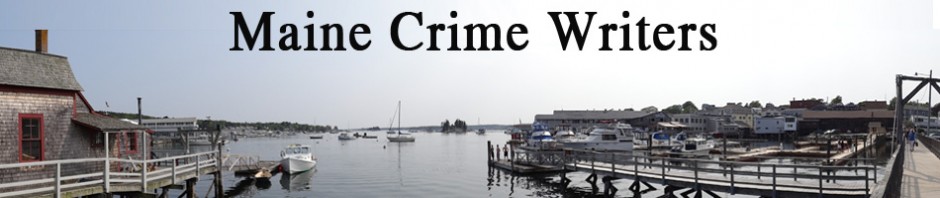

If you aren’t looking, you won’t see the special visitor outside the door
Kate Flora: One January, we rented a funky apartment on Russian Hill that belonged to a writer. Writer’s house meant writer’s books. One that I picked up and promptly got lost in was called Writers Workshop in a Book. My meanderings through that book tuned up my own sense of the importance of using our senses to see the world, and then rendering that world for our readers. In his essay, A Writer’s Sense of Place, James D. Houston talks about location and the power of landscape. Houston writes:
The idea of a sense of place is nothing new, of course. It has been a constant in human life from day one. You can’t avoid it. You have to park somewhere, have a roof over your head, and wherever this happens has to be a place of one kind or another. But we’re not always aware of it as such. At some point, places move into the conscious life. When that occurs, we begin to have a sense of it, an awareness of it and our relationship to it.
Many of us live and write in Maine because that particular sense of place is important to us. Because being surrounded by a place that forces us to deal with it makes it harder not to notice. Maine weather is a significant factor in our planning. It can be aggressive and demanding. It affects what we wear, what we carry in our cars, how attentive we are to the tread on our tires, what the challenges of a journey from point A to B may be, and whether we might postpone our trip for another day. Whether that chill in the air makes us dream of fish chowder or a cup of our favorite tea. Sometimes one of our more perilous winter drives fetches us up at home longing for something stronger. Sometimes the air is so cold and damp we can literally smell that snow is coming. And the crunch of snow underfoot is different depending on how cold it is.
Our environment, whatever the season, finds its way into our storytelling. We write about

Exposure to other writers’ ways of seeing is also part of writing
how a hot summer brings such an excess of tomatoes we want to stop cooking and canning and have a tomato war. We write about how the summer heat in a city cooks the streets and trash into a pungent, fetid brew. We write about how to survive a fall through the ice because falling through the ice really happens. We write about the smell of the Maine winter air because we’re more likely to be moving through it and notice, rather than going from enclosed home garage to parking garage to offices with canned air.
But sometimes, as James Houston reminds us in his essay, our own environments become commonplace. We stop seeing them. Then we must take steps to get ourselves reconnected.
Going away to someplace different can have the effect of retuning our senses. Noticing the sounds of a city, instead of the country can remind us of what it sounds like at home. Different noises at night can remind us of what the sounds of our own houses are like. What bangs and dings and hums and creaks have become so familiar they are invisible. We notice anew what vehicles go past and what their tires sound like. How far away sirens carried over the Maine water are not like emergency vehicles roaring through the canyons of city streets. What it is like to watch the multiple reflections of a fire engine off nearby windows, as opposed to our neighbor’s strange red bathroom light seen through a filter of trees.

Maybe it’s just a boat in the water or maybe it’s am amazing reflection and contrasts of colors
As we write, drawing on those real world observations, our thoughts are turned inward. We’re hearing the voices of our characters and not the voices of those around us, walking darkened Portland streets instead of the streets in our neighborhoods. We’re in a patrol car with a flashing light bar and not in the real world. But as we create those environments for our characters, we are bringing in our observations of the real world. We are importing the smells and sensations, the rustlings of oak trees that never shed their leaves, the delicious scents of cooking dinner or the sour rot of trash in an alley. We are using the observations we’ve trained ourselves to make to make our fictional situations feel authentic, and we are taking the additional step of learning to filter those observations through the eyes of the characters we’ve created.


Thanks for the experience. I traveled on your words to moments in my life.
And perhaps write your own as well, Dana
Thank you for reminding us to stop and to notice.
I do it as much for me as for you. Too easy to keep out heads down and not look around, right?
And by recreating some of those awarenesses in our writing, we can offer those experiences to readers who might not have access to anything like them.
So true, John. We can let those Florida writers take us there, while we bring our readers to authentic Maine.
Nice perspective. Thanks.
Awesome post. It’s in the details.
Absolutely, Kait. Too easy to scoot past and not take the time to create that sense of place.
Russian Hill is such a great neighborhood. Now I am speculating on whose apartment you visited…
Karen94066 at aol.com
Sands Hall…on Macondray Lane, as I recall. It was a few years ago.