 I had a chance to teach an online class this past weekend for Great Lakes Fiction Writers titled “Working with an Editor & Self-Editing Tips.” It was well-attended and recorded for their membership.
It was a really nice opportunity to think about my process, and how it’s evolved. I just submitted my next manuscript’s final edit to my editor, so I had much to say about that process, but I actually spent most of the time talking about self-editing.
I started by assuring my students that process is personal. That a writer has to find what works for them, and also acknowledge that your process may change depending on length, genre, or nature of the project.
Walter Mosley once said that “your novel is bigger than your head,” by which I’m sure he meant a great many things, but one of the takeaways for me has always been that it’s enormously difficult to wrangle the entire project at once. So, for me, that means multiple editorial passes, each with its own purpose.
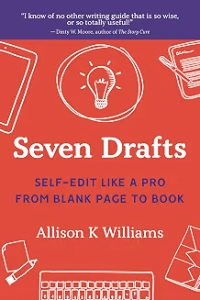 I base my process off of the one Allison K. Williams espouses in Seven Drafts: Self-Edit Like a Pro from Blank Page to Book, but have adapted it to the challenges unique to my writing. That’s the evolution of my process. Now having worked with multiple editors and done major rewrites to multiple manuscripts, I know where my writing challenges are.
Nowadays I can get a draft down on paper pretty reliably. It’s not always smooth, not always consistent, and usually pretty ugly. Then the fun begins.
Allison K. William’s Seven Drafts are:
- The Vomit Draft (aka, the “Shitty First Draft,” Williams also channels a friend’s kinder epithet, thinking of this draft as grocery shopping and editing as making a meal)
- The Story Draft (in which you pay attention to plot and structure)
- The Character Draft (in which you refine characters, make their voices consistent, and consider dialogue)
- The Technical Draft (what most of us think as editing: POV, sequencing, show don’t tell, pacing, line editing, and word choice)
- The Personal Copy Edit (formatting and style)
- The Friend Read (beta readers if you have them)
- The Editor Read (either on your own nickel or by your press)
I follow most of her model, though I add a few more based on what editors have helped me to see as consistent challenges I have or that I know I undoubtedly have to improve. So, my drafts are:
- First Draft
- Story Draft (since I write in multiple POVs, this also looks at each narrator’s arc to make sure it is consistent and compelling)
- Character Draft (voice is especially important here for me, making each POV unique)
- Detail Draft (essentially world-building, a full read through in which I ask in every paragraph, is it clear where we are, when we are, what senses are being activated, what grounds us)
- First Technical Draft (looking at chapter, paragraph, and sentence lengths, dialogue vs. narrative)
- Emotion Draft (aka Character Draft 2–since I write thrillers, sometimes I can let the plot dominate the characters, so I need to make sure I am expressing how the circumstances and action affect them)
- Second Technical Draft (now looking at spelling, grammar, and my “Tic List”–I’ll come back to that)
- Read Aloud Draft (I have Word read me the manuscript aloud. Amazing what you catch here, from inconsistent voice to repeated words, to clunky sentences)
It’s not much different from Allison K. Williams’s, but where it is, it’s because it addresses weaknesses in my initial drafts, like details and character emotions.
Probably the least fun part of the process for me is processing the “Tic List.” This is a list of words I know I over utilize or let clog up the prose: but, and, had, that, very, even, etc. The list goes on to over 200 words I try to cull. That pass as part of the Second Technical Draft often removes several thousand words, to my initial surprise!
Then, of course, I do parts of all this over again after I get my editorial line edits! No doubt the process will continue to evolve but it does allow me to, at least in part, make the novel not much bigger than my head.
 Always filling in the classics I never got around to. This week I’m diving into John LeCarré’s The Constant Gardener, 2004.
 Next up in my TBR is Emily St. John Mandel’s Exit Party, 2026.


